Game Designer - Narrative and System Design
gd
Antonio Reis
Game Designer - Narrative and System Design
Game Designer - Narrative and System Design
gd
_Game Designer - Narrative and
↓ Experience and Projects ↓

Game Design Internship - Volt Games
Dreamscape
Heart and Mind
The Shadow Over Innsmouth
Total 11
Sarmale
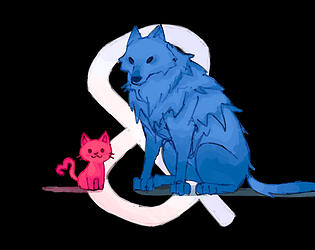
Heart & Mind (Original prototype)
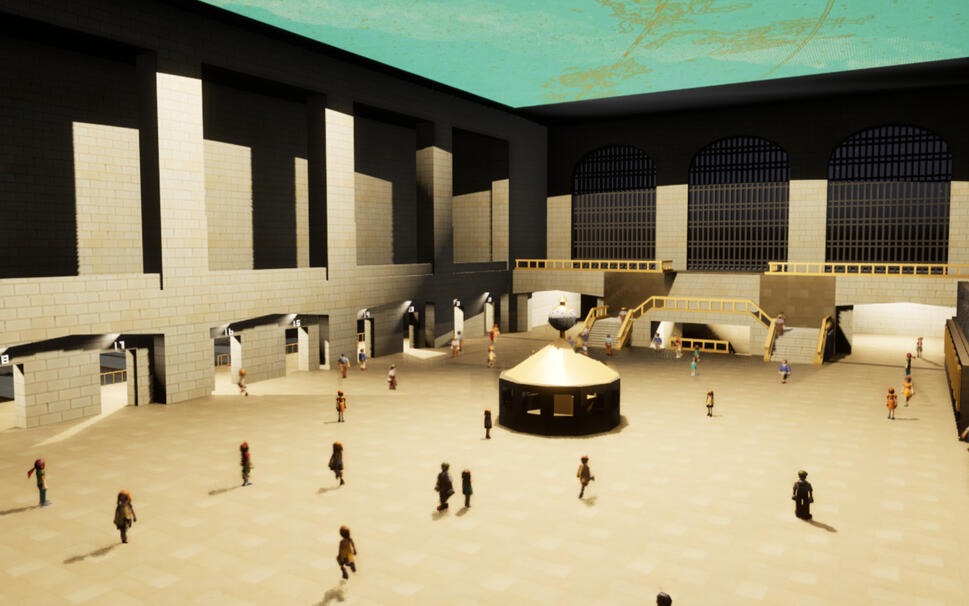
Grand Central Run
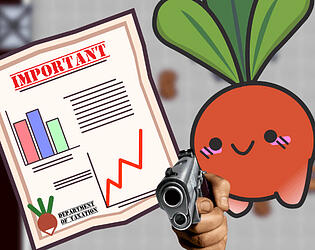
Radish Boy Commits Insider Trading
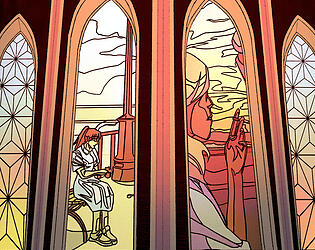
Splendid Strangers
_Game Designer - Narrative and
R
Resume
Click on the image on the right to get a better look.
R
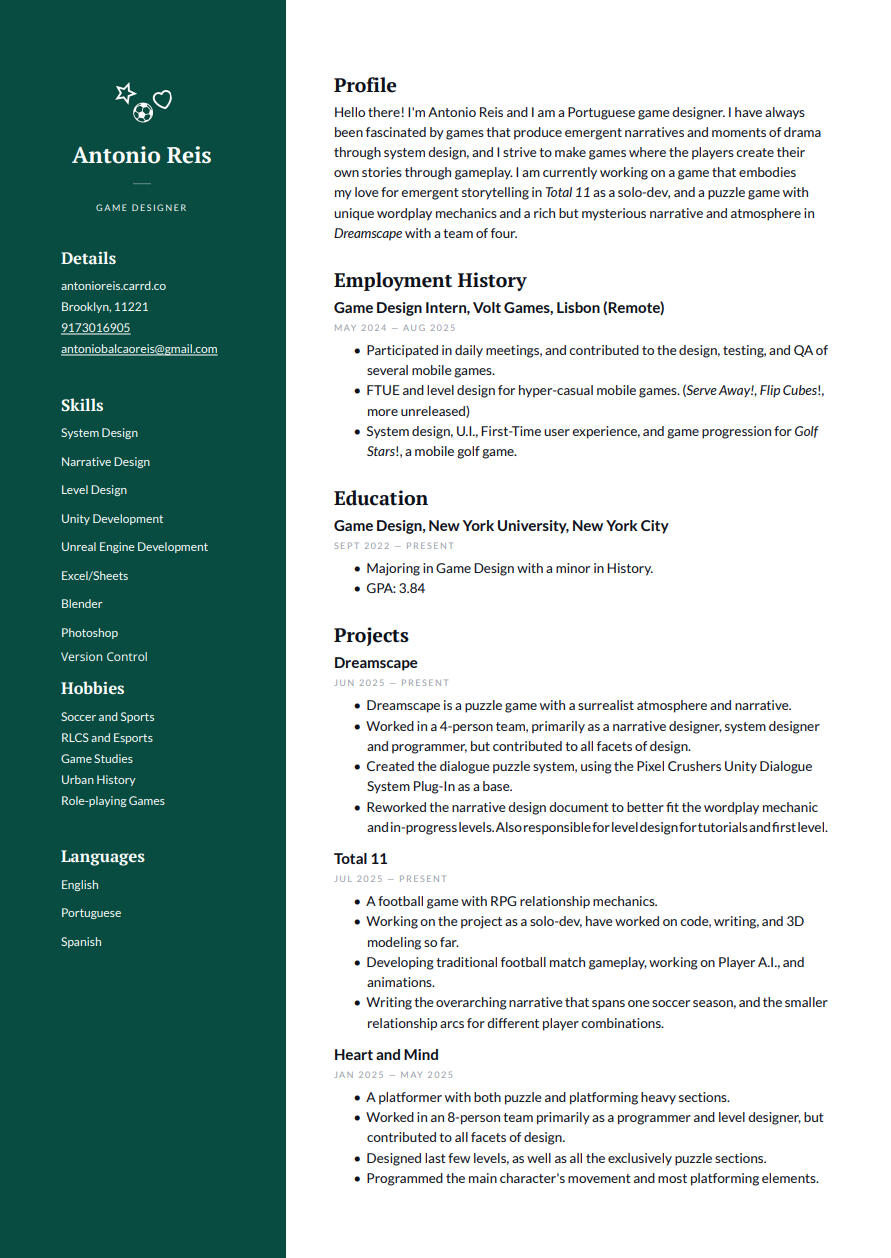
R
Work Experience
Volt Games
Game Design Intern, May 2024 - Aug 2024
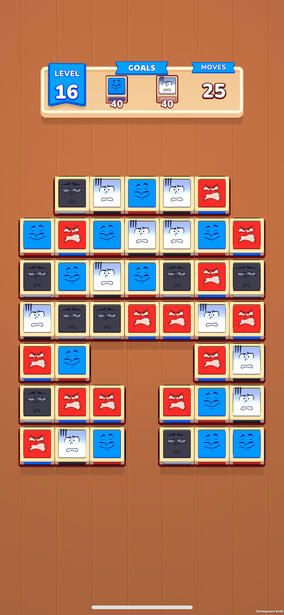
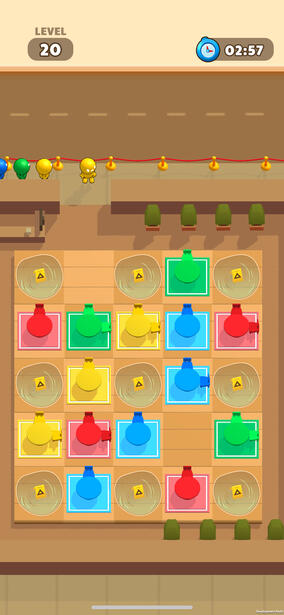
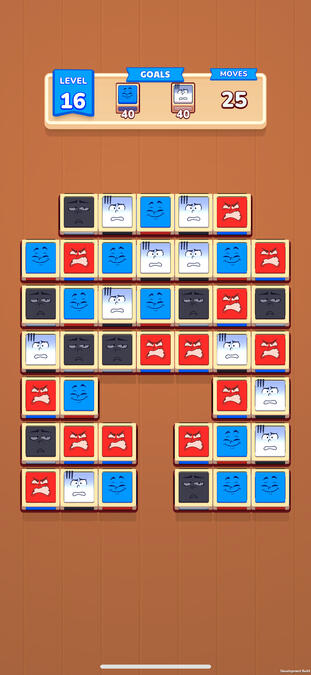
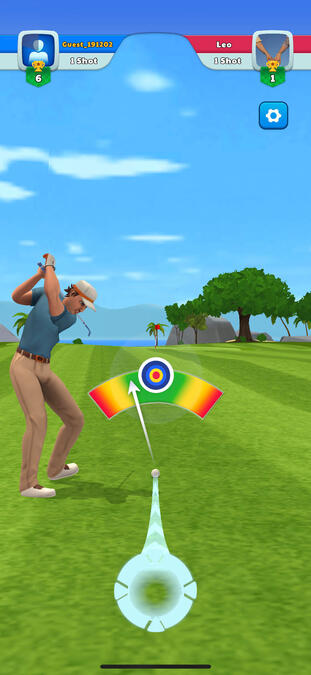
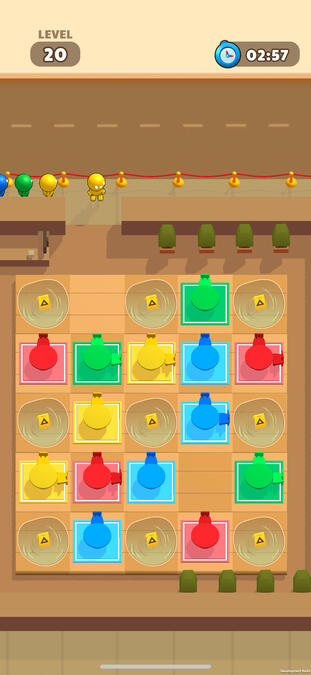
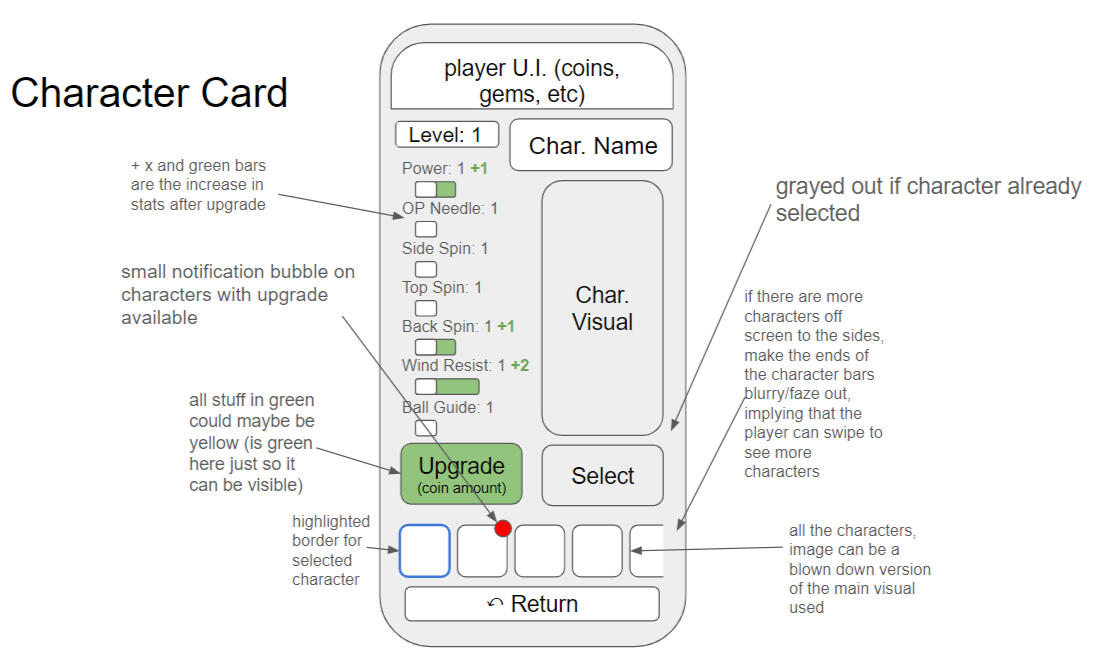
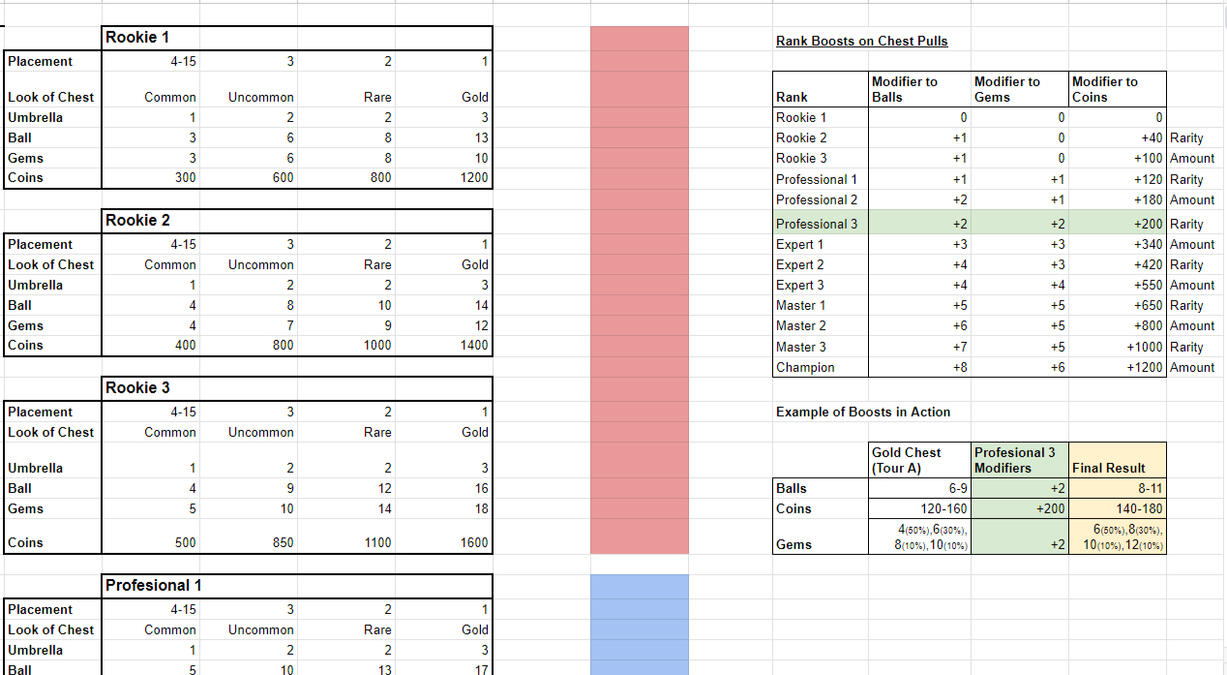
Over the course of three months I worked as a part of the Volt Games design team and contributed to multiple mobile games' design and testing.I was the lead level designer for multiple hypercasual mobile games (Flip Cubes!, Serve Away!) some of which were not released, and also designed tutorials for them.I worked on two mobile sports games, one of which has not been released yet, and the other has an early build available for testing. I contributed to gameplay design, the design of the leaderboard system, game progression, First-Time user experience, and U.I.Click on the U.I. wireframe and Design Doc to see more.
Work Experience
Game Design Intern, May 2024 - Aug 2024

Flip Cubes!
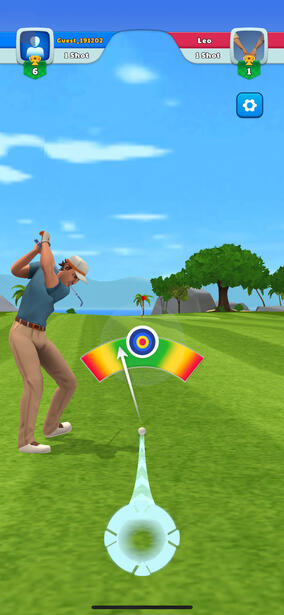
Golf Stars!

Serve Away!

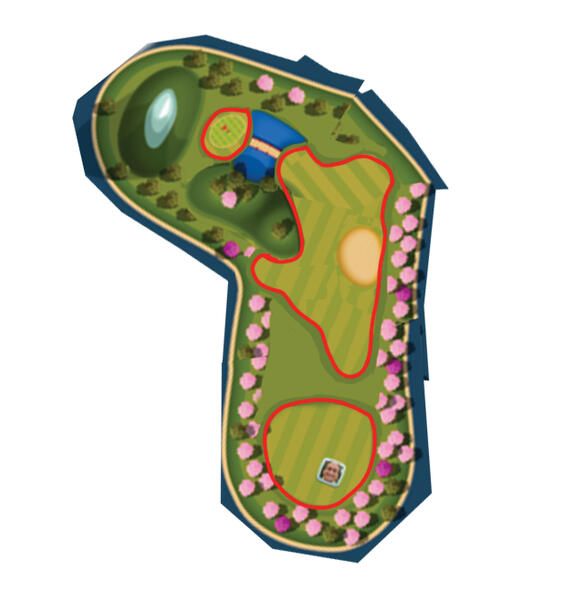
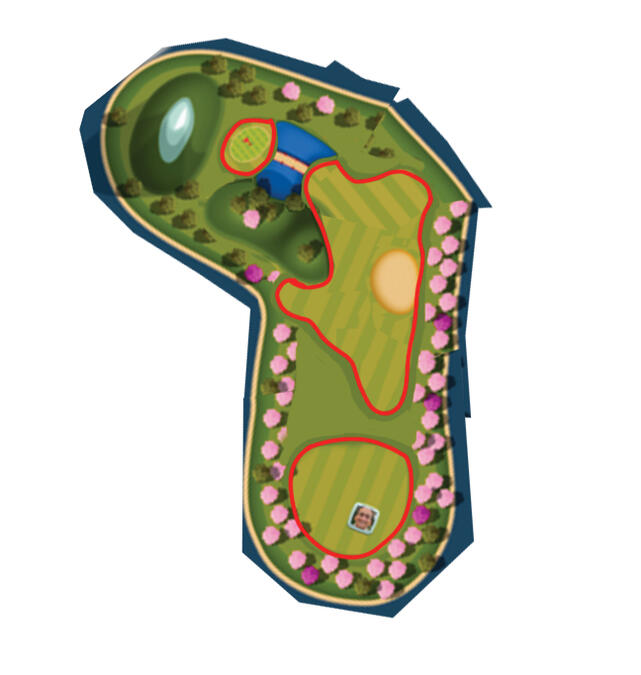
Map designed for Golf Stars!

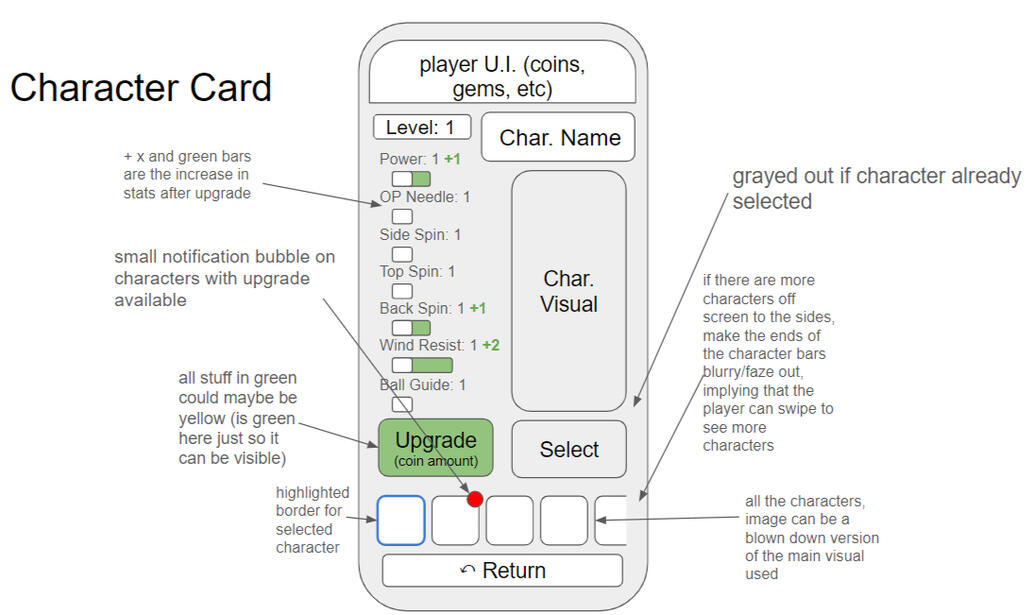
U.I. for Golf Stars!

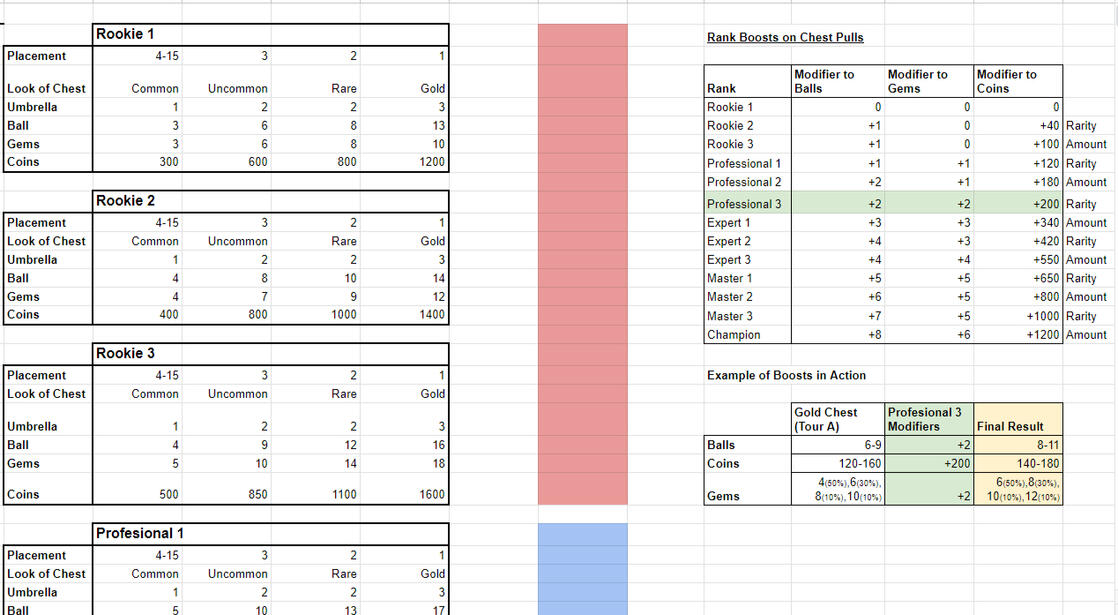
Design Document for Golf Stars!
R
R
Writing and Narrative Design
R
Splendid Strangers
Published: Apr 09, 2023
Roles: Designer and Programmer
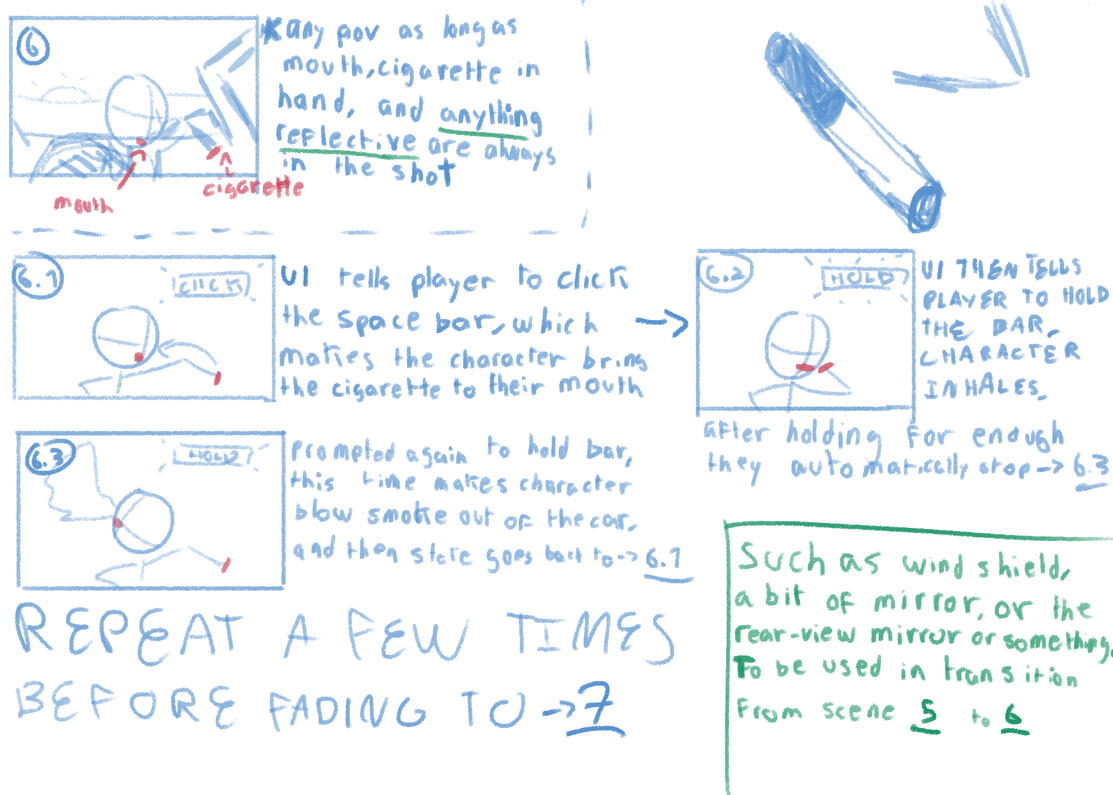
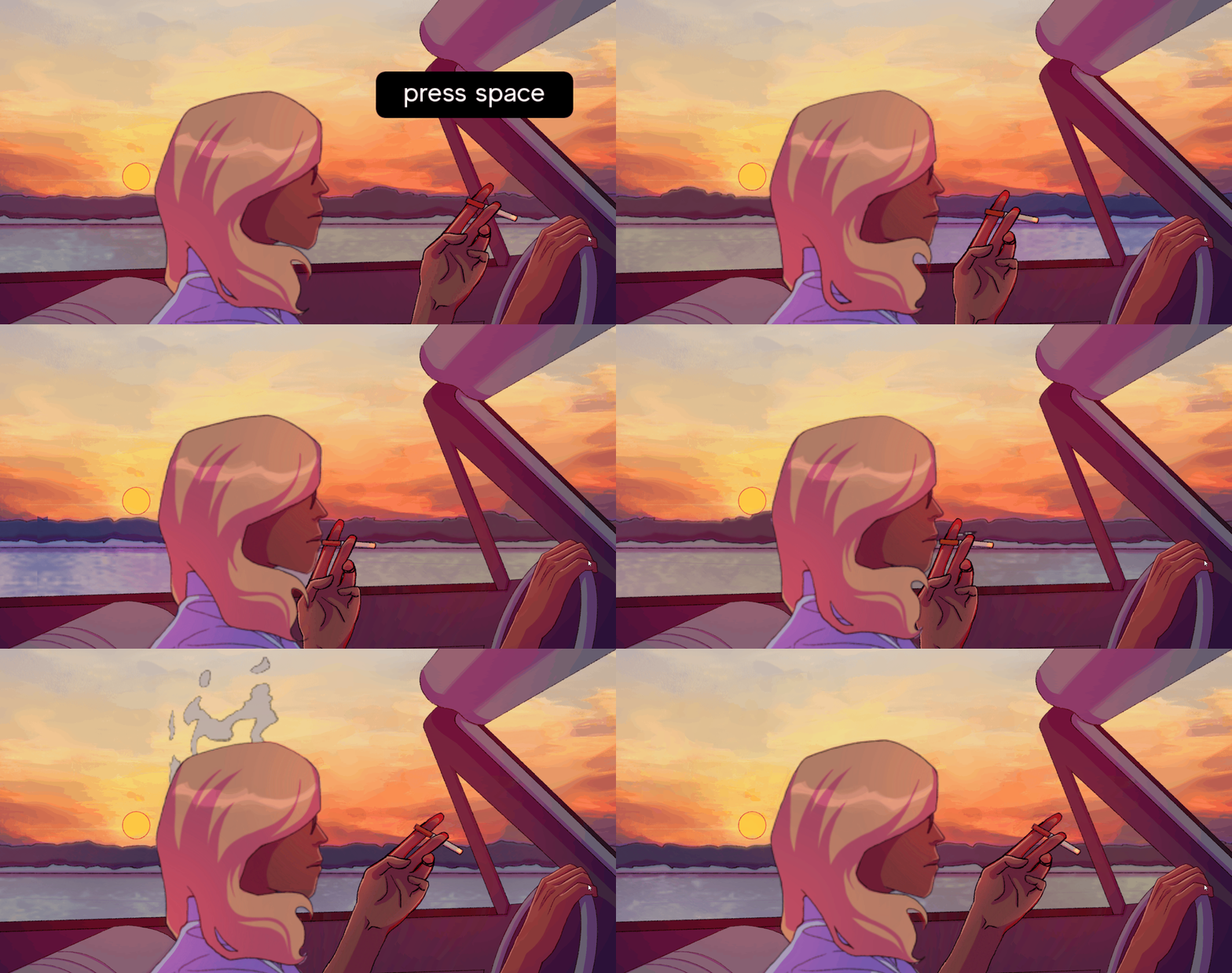
Splendid Strangers is a short narrative game about the beauty of ordinary people and ordinary life, based on Leslie Jamison's 2019 essay "The Photographs That Made Me Feel Less Alone".The main objective of the game was to create a slow and introspective experience, where the player is invited to appreciate mundane yet beautiful moments.I programmed and designed the two "mini-games" and drew rough storyboards of the entire game to serve as a reference for the rest of the team.To look at all the storyboards click on the storyboard to the right.
Splendid Strangers

Storyboards

Smoking GIF
Heart & Mind
Published: Nov 16, 2024
Roles: Designer and Programmer
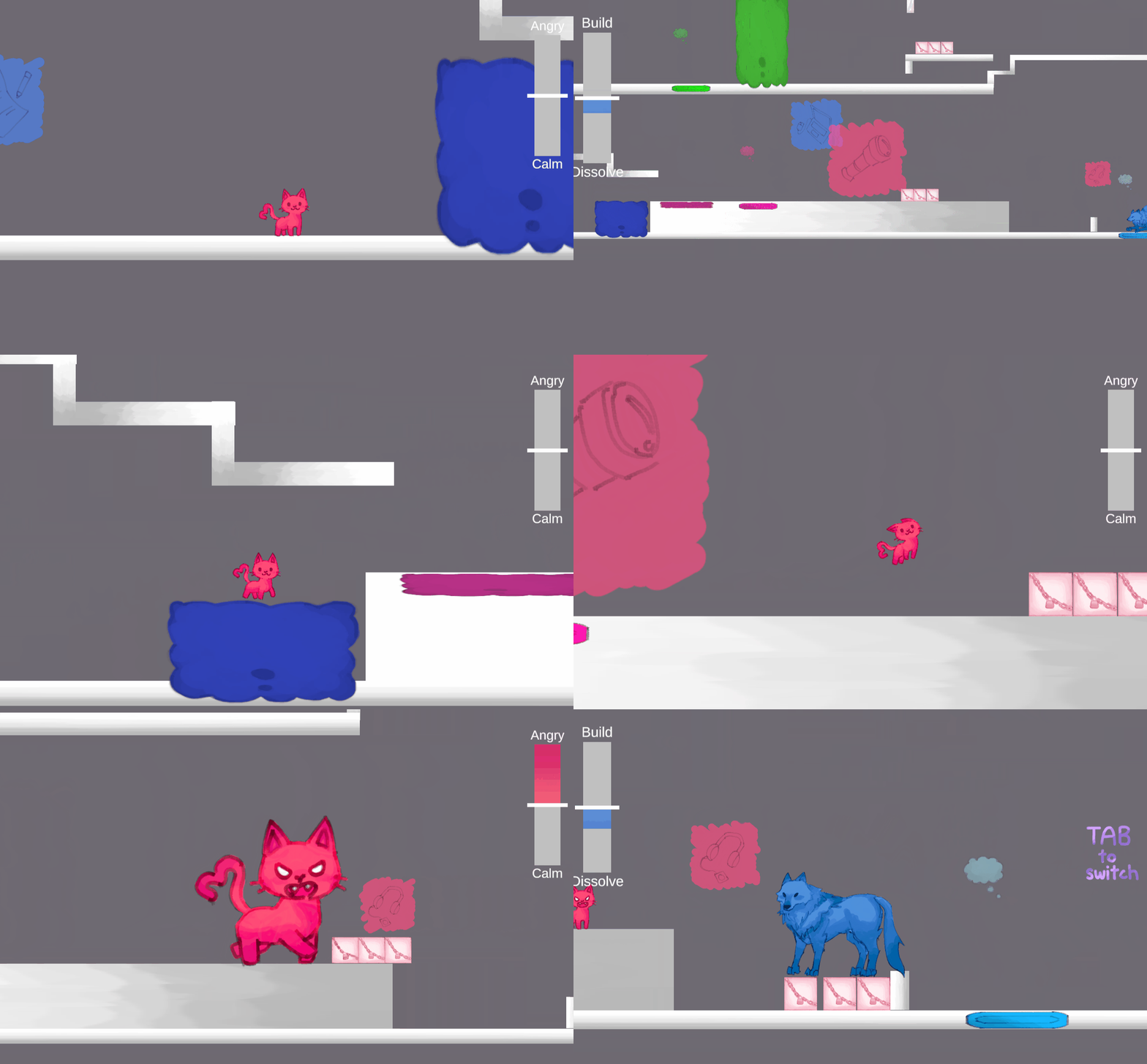
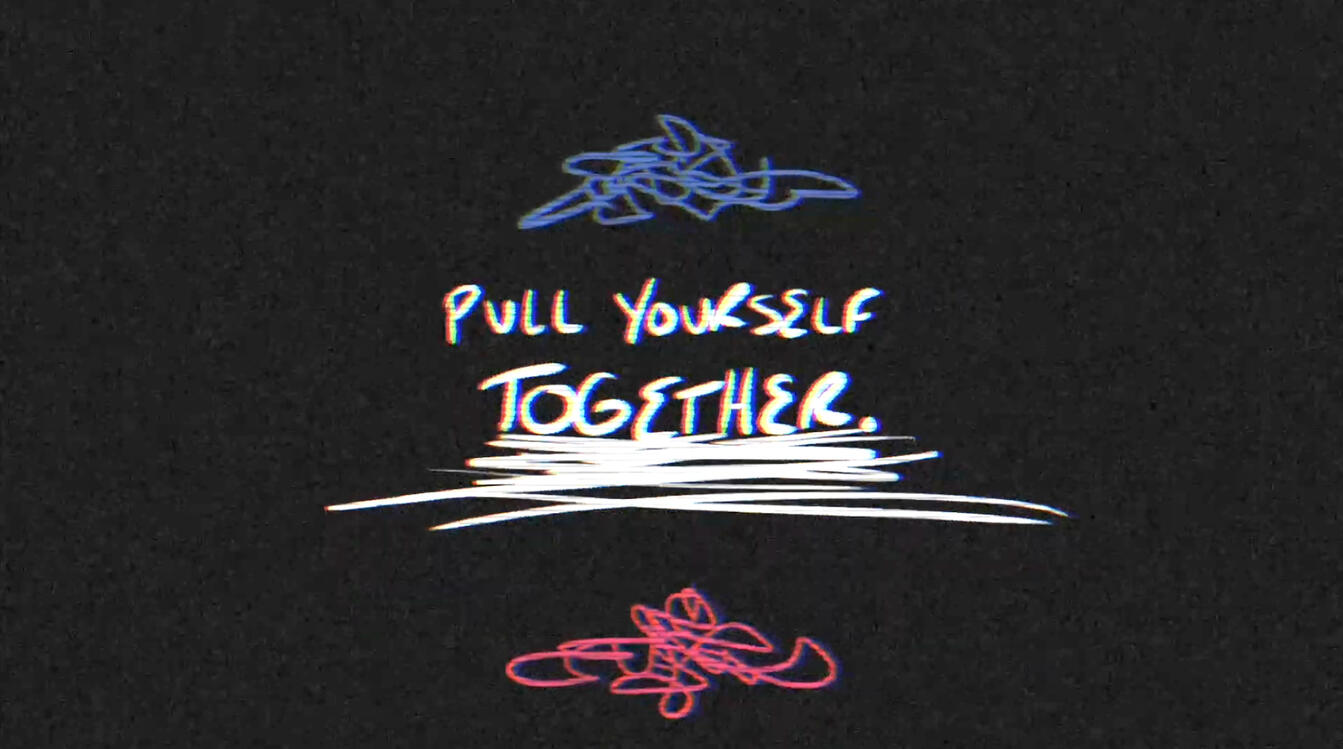
Heart & Mind is a narrative puzzle platformer, where the player takes control over a character's Heart and Mind, personified in the form of a cat and wolf.The game consists of two Heart and two Mind levels, with one final level where the player takes charge of both at the same time. Levels have dialogue and there are small cutscenes in between showcasing the main character's struggles in real life.During development, I was the go-to coder and level designer. As the lead programmer, I was also able to constantly change and improve the puzzle mechanics, the Mind's platform manipulation in particular, as I designed the levels.While designing the final level, constant playtesting was also extremely important. As the rest of the team sent me videos of them playing through the level, I made numerous changes according to what I saw in their gameplay, be it because I liked how one of them approached a particular problem, or because they found an unsatisfying and easy solution.
Splendid Strangers
The Circus Of Laughs
Published: Jan 29, 2024
Roles: Designer and Programmer
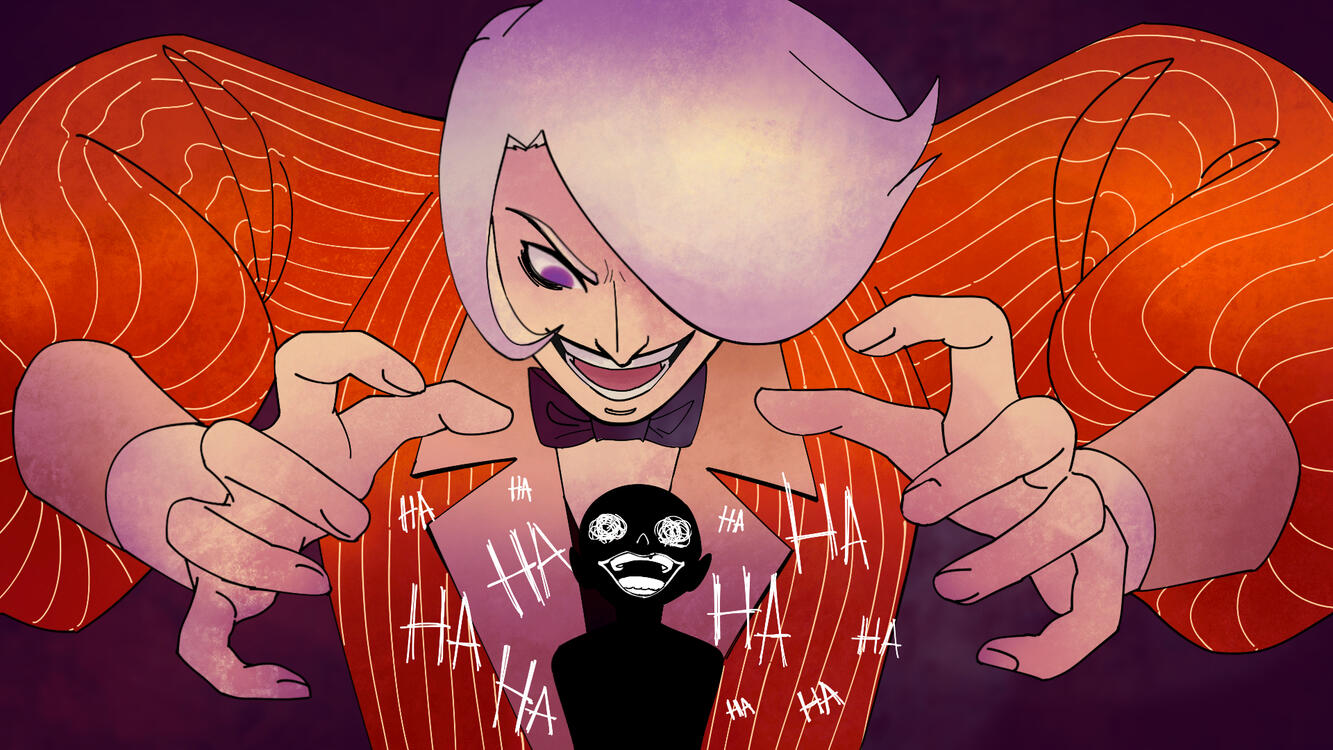
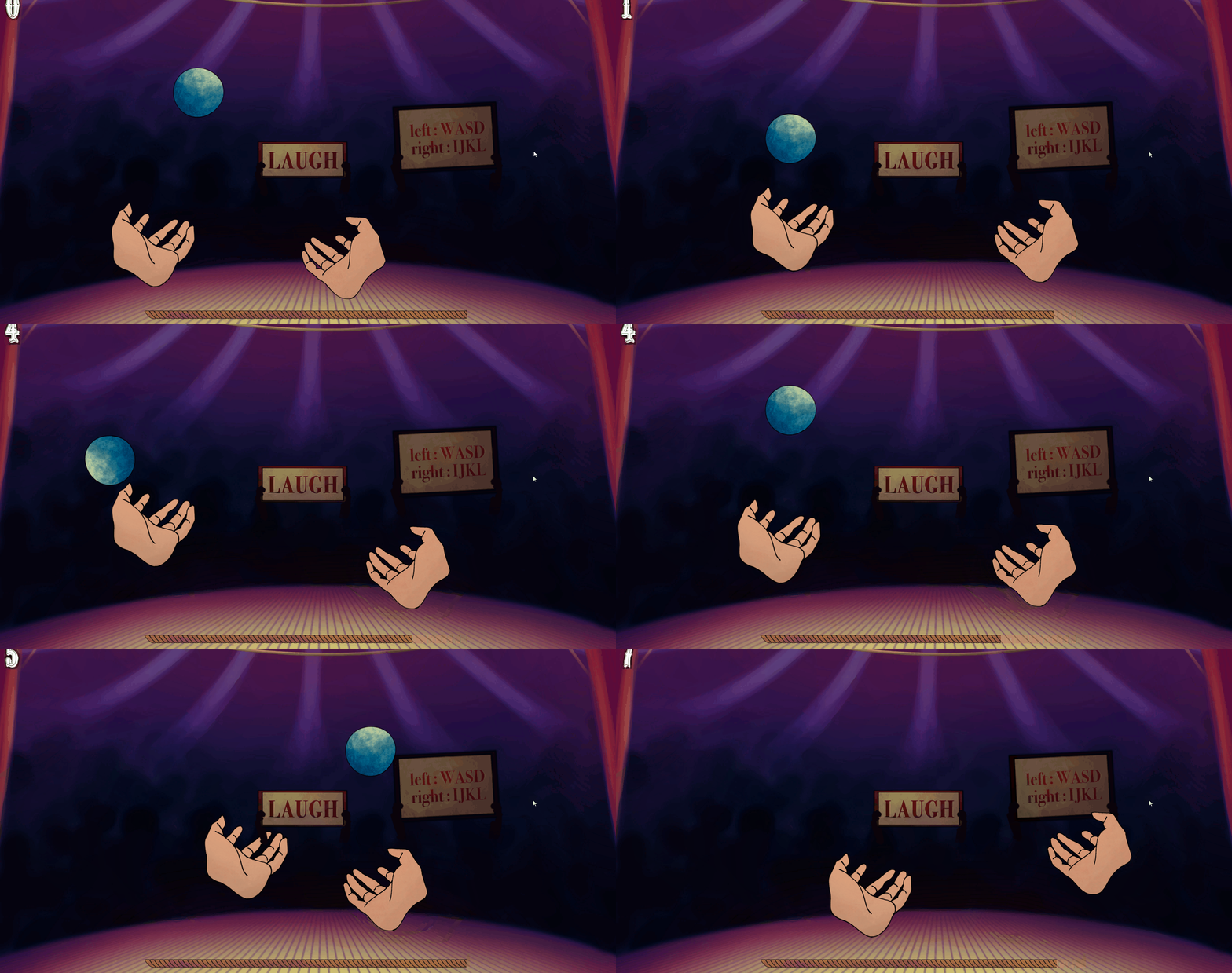
The Circus of Laughs is a visual novel where the player has to get through two mini-games to progress through the story.It was developed in under 48 hours for the 2024 Global Game Jam, in which it was nominated for Best Overall Game at the New York University Jam Site.The main gimmick of the game is that the player must audibly laugh while playing the two mini-games, which were designed and programmed by me, to survive, which I implemented using the Hugging Face Unity API.
Splendid Strangers
The Shadow Over Innsmouth
Published: Nov 01, 2024
Roles: Writer and Narrative Designer
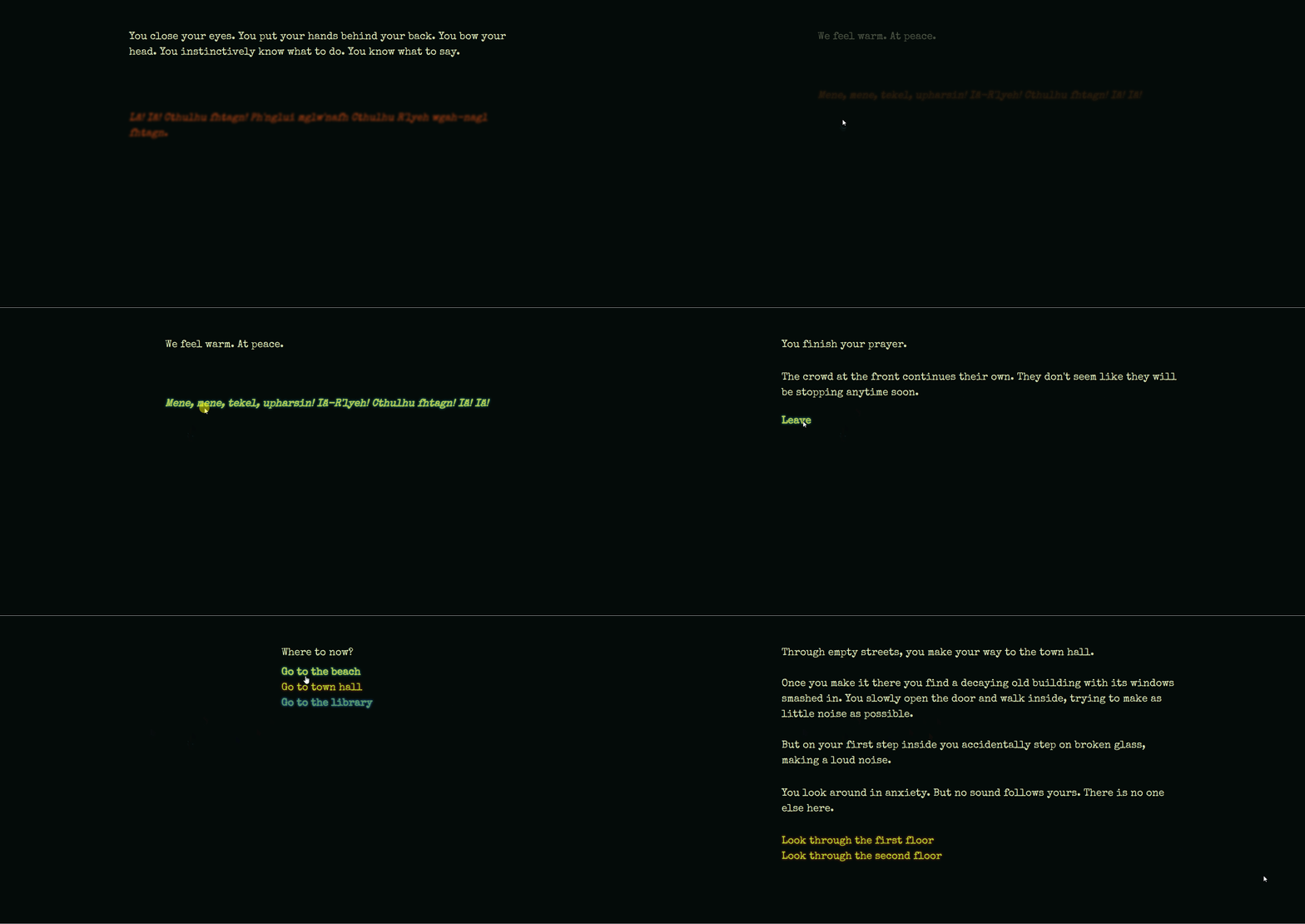
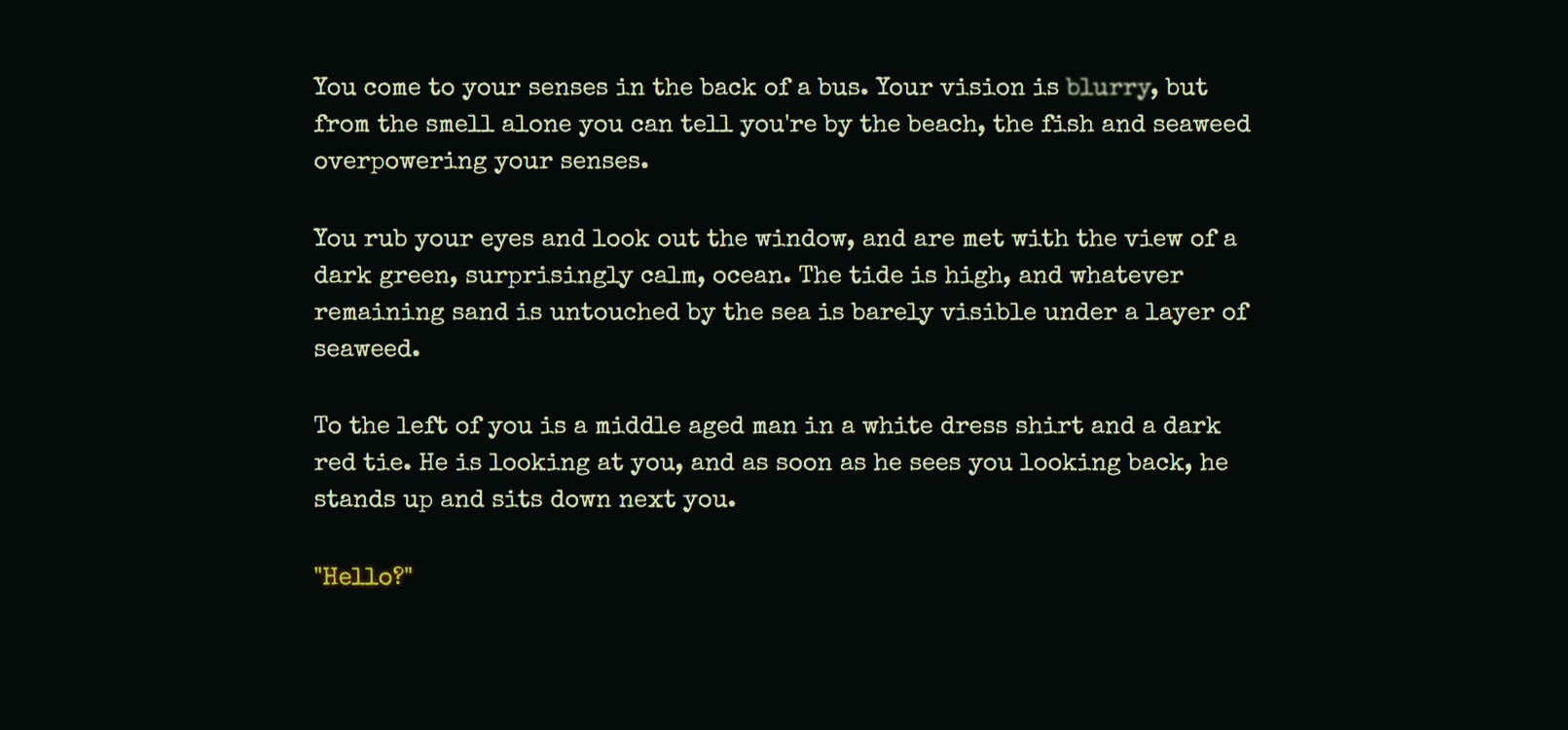
The Shadow Over Innsmouth is an adaptation of H.P. Lovecraft's novella of the same title, with a largely original plot, and 3 unique endings.I reread the story at the beginning of the development process, during which I took notes about the characters, setting, language, and verbs, as well as verbs that I felt could work interestingly in the context of the setting but weren't present in the original, such as prayer.While writing the game I paid special attention to tone and mood, creating an uneasy feeling in the player through the environment and small uses of visual effects in the text. I also utilized background variables to keep track of the player's choices, such as how often the player followed the rules and traditions of the town.
Splendid
Radish Boy Commits Insider Trading
Finalized: Dec 20, 2023
Roles: Designer and Programmer
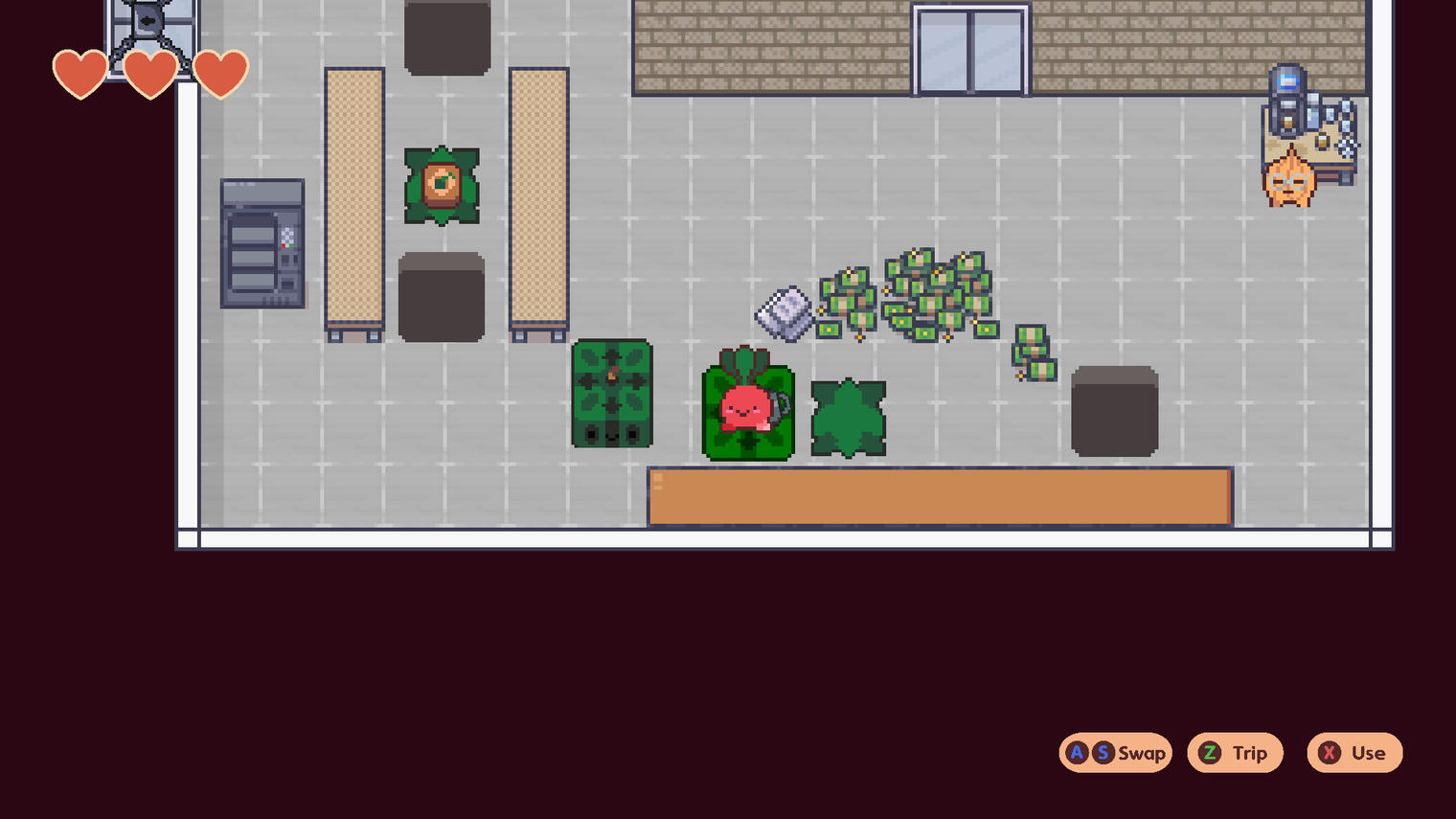
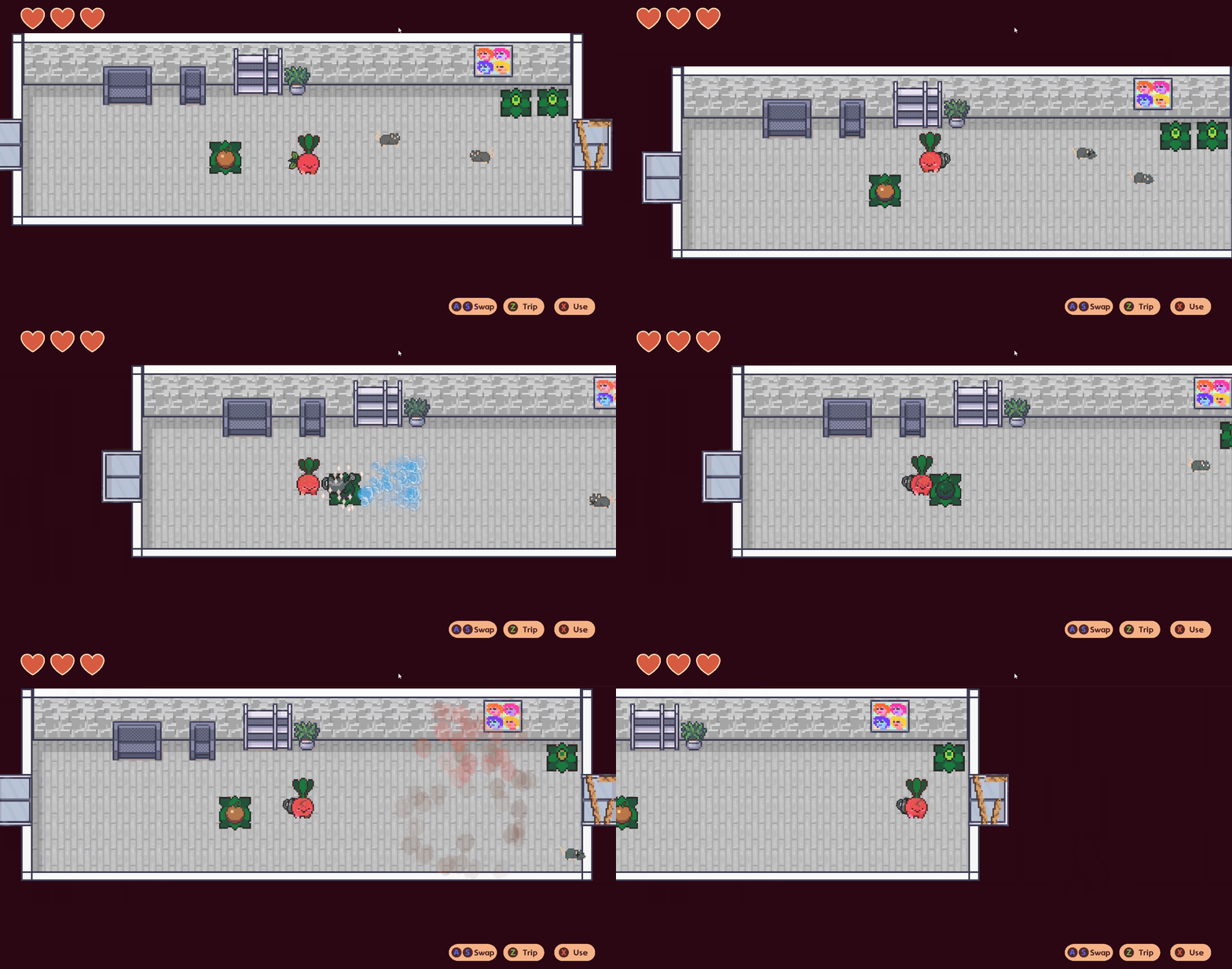
A fanmade sequel/homage to Turnip Boy Commits Tax Evasion (2020). Radish Boy is a 2D adventure game featuring the watermelon, sword, watering can, and bomb of the original, with the inclusion of the gun mechanic.The biggest question we had while developing the game was how could we make the gun an interesting puzzle-solving tool, and not just a weapon for combat. The answer to this was in the interactions that it could have with other systems. It takes 3 bullets for the grown watermelon to break, and non-breaking shots push the watermelon along the floor, and if a bomb has been watered, a bullet will make it explode. Both of these unique interactions are essential pieces to the puzzles that we then designed as a team for the game.
Splendid Strangers
That Time I got Reincarnated and Cursed My School
Published: Feb 19, 2023
Roles: Designer and Programmer
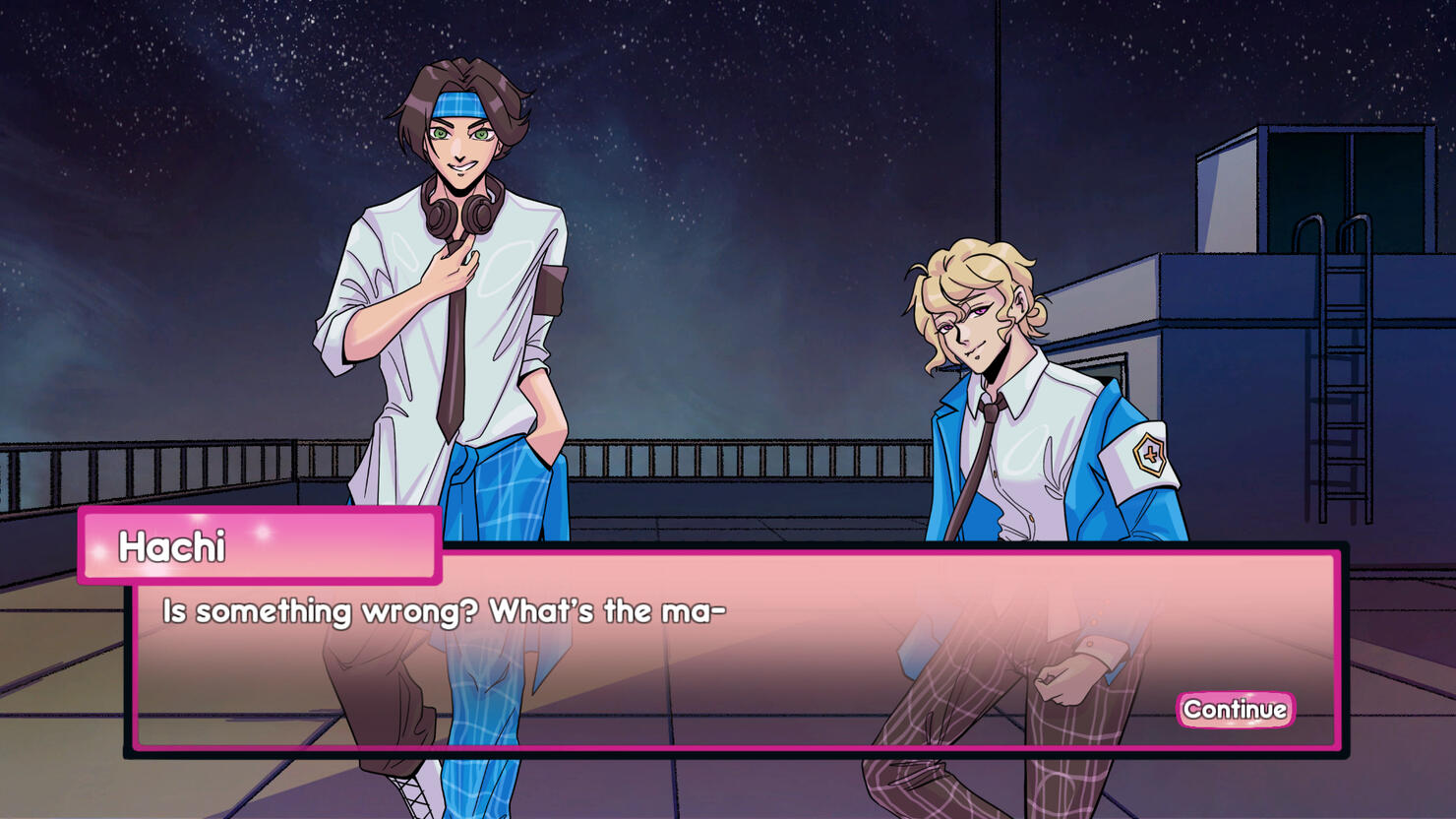
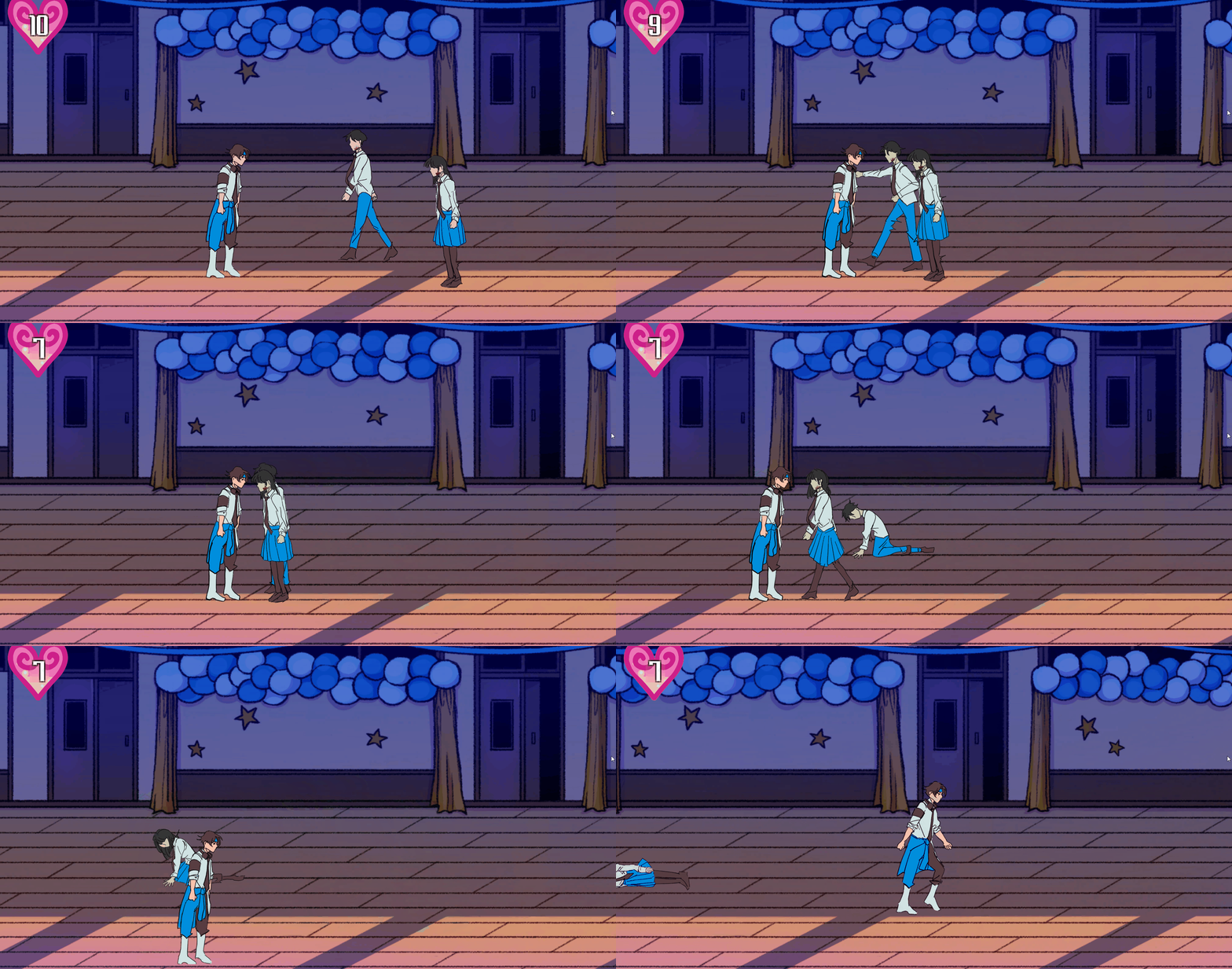
A visual novel beat 'em up game developed in a week for the 2023 Brackeys Game Jam.The player must make their way through five floors of possessed classmates to reach the school roof, fight their best friend (the game's final boss), and confess to the love interest.I was the sole programmer for this project and designed the combat system and final boss.
Splendid Strangers
A Snowy Day
Finalized: Sept 27, 2024
Roles: Writer and Narrative Designer
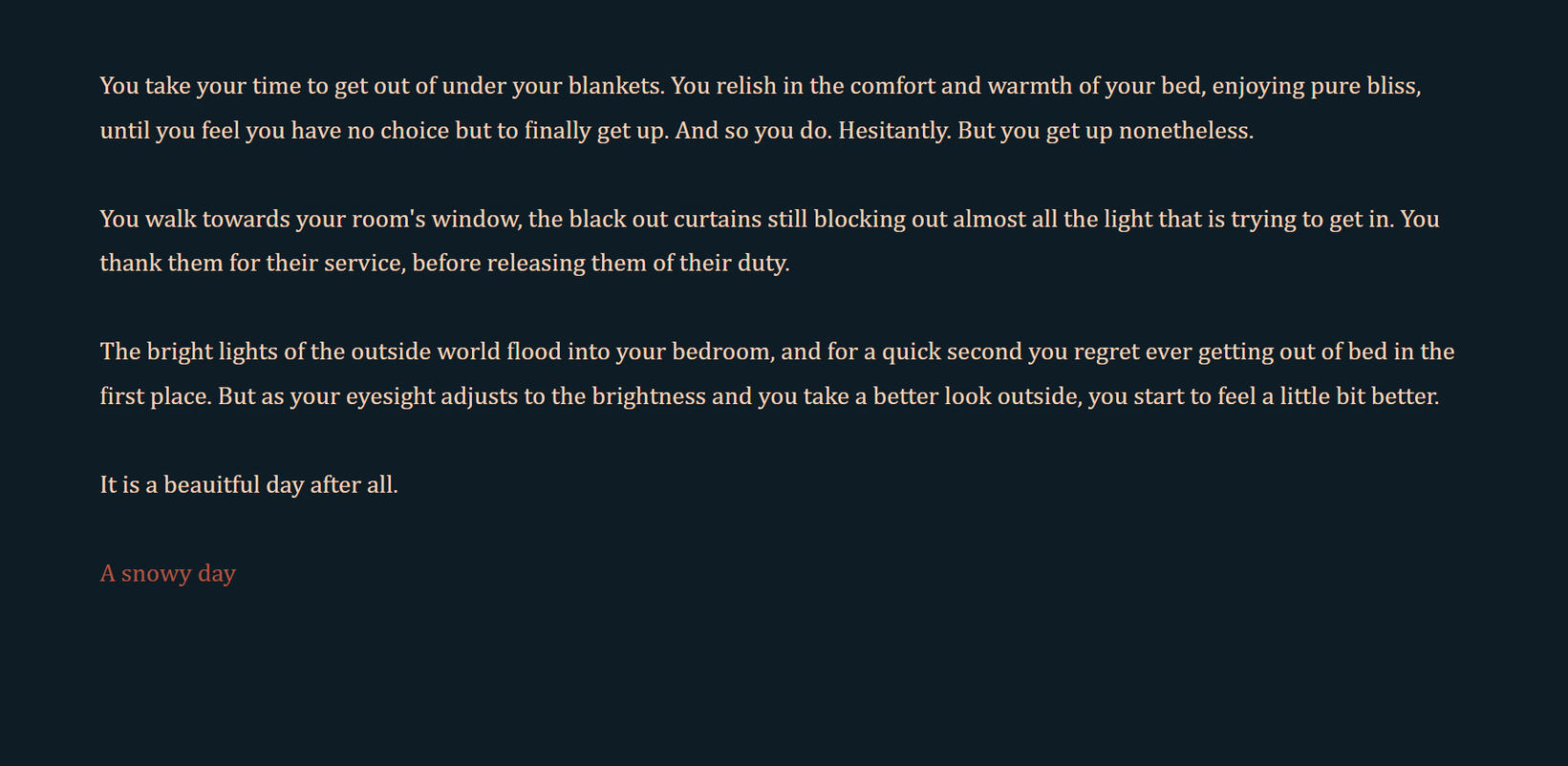
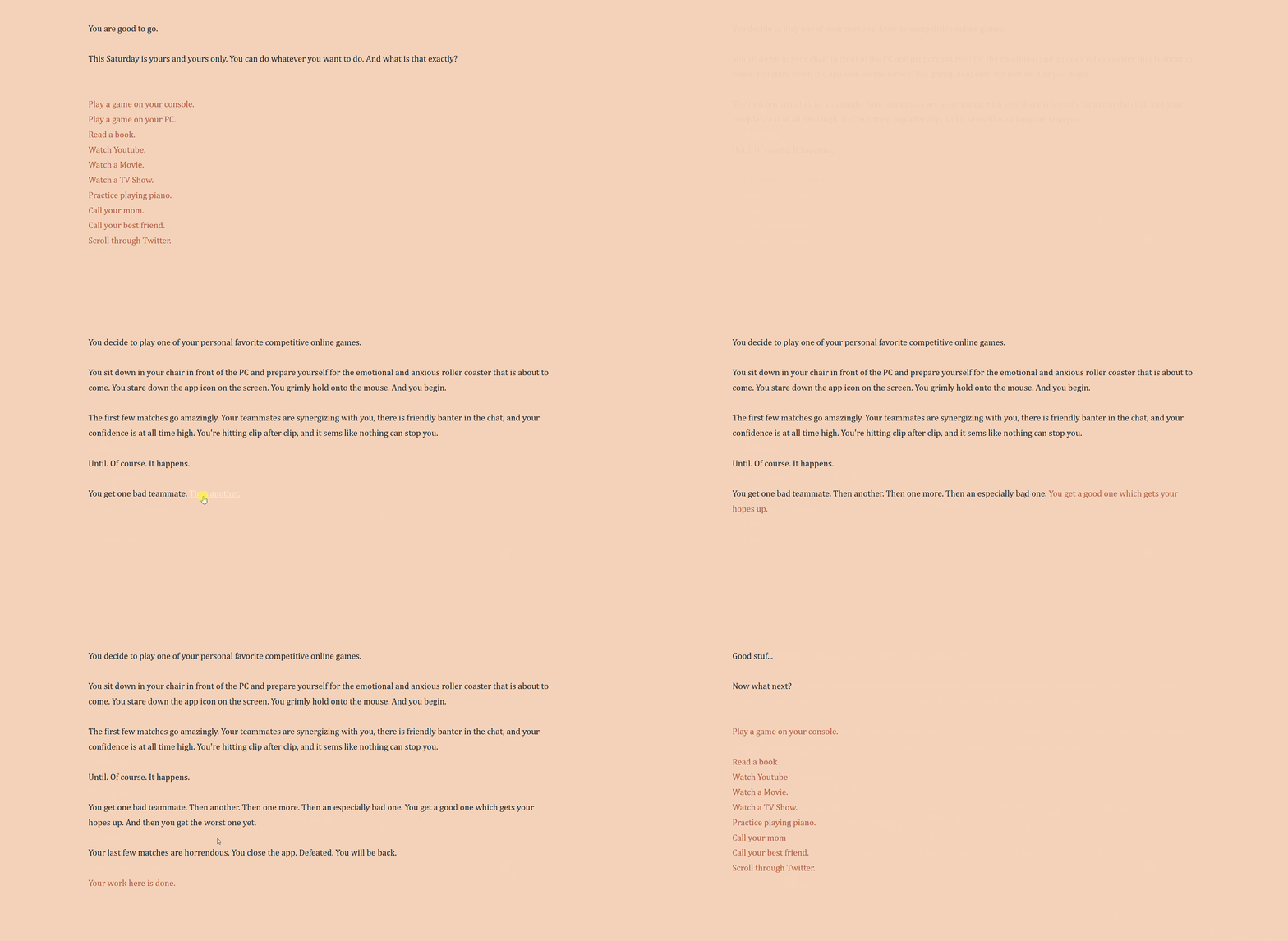
A Snowy Day is a short and cozy narrative game prototype made as a solo dev in Twine, where the player experiences a day off in a snowstorm alone at home, free to do whatever they want.The game was made in under a week for a game development class, with the main objective being to create an experience that was cozy and humorous, but not satirical or wacky.The consists of the morning routine and the 10 choices that the player has on what to do during the day. Depending on what they choose, they will get a different ending message reminiscing on the day.
Splendid Strangers
Crazy Boarding
Finalized: Oct 04, 2024
Roles: Designer and Programmer
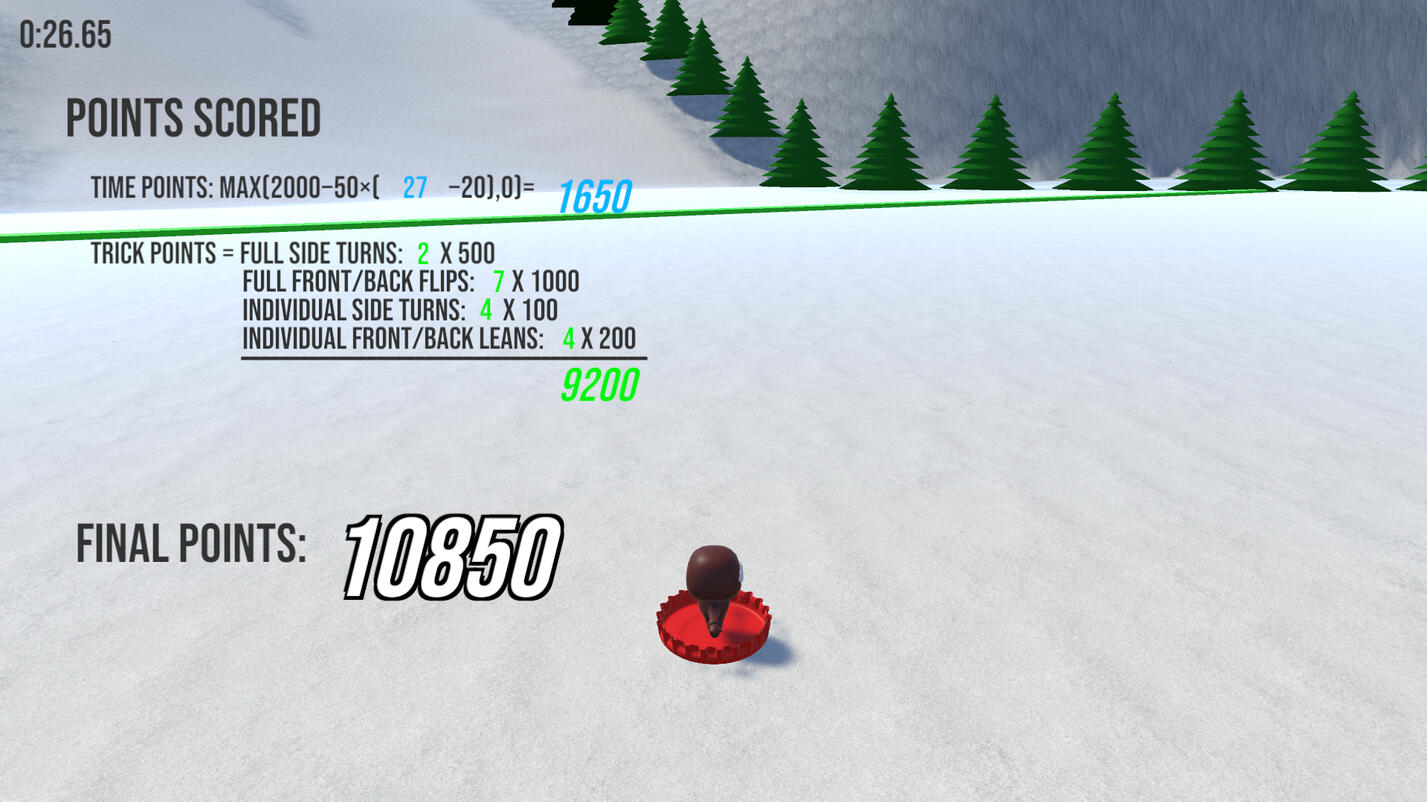
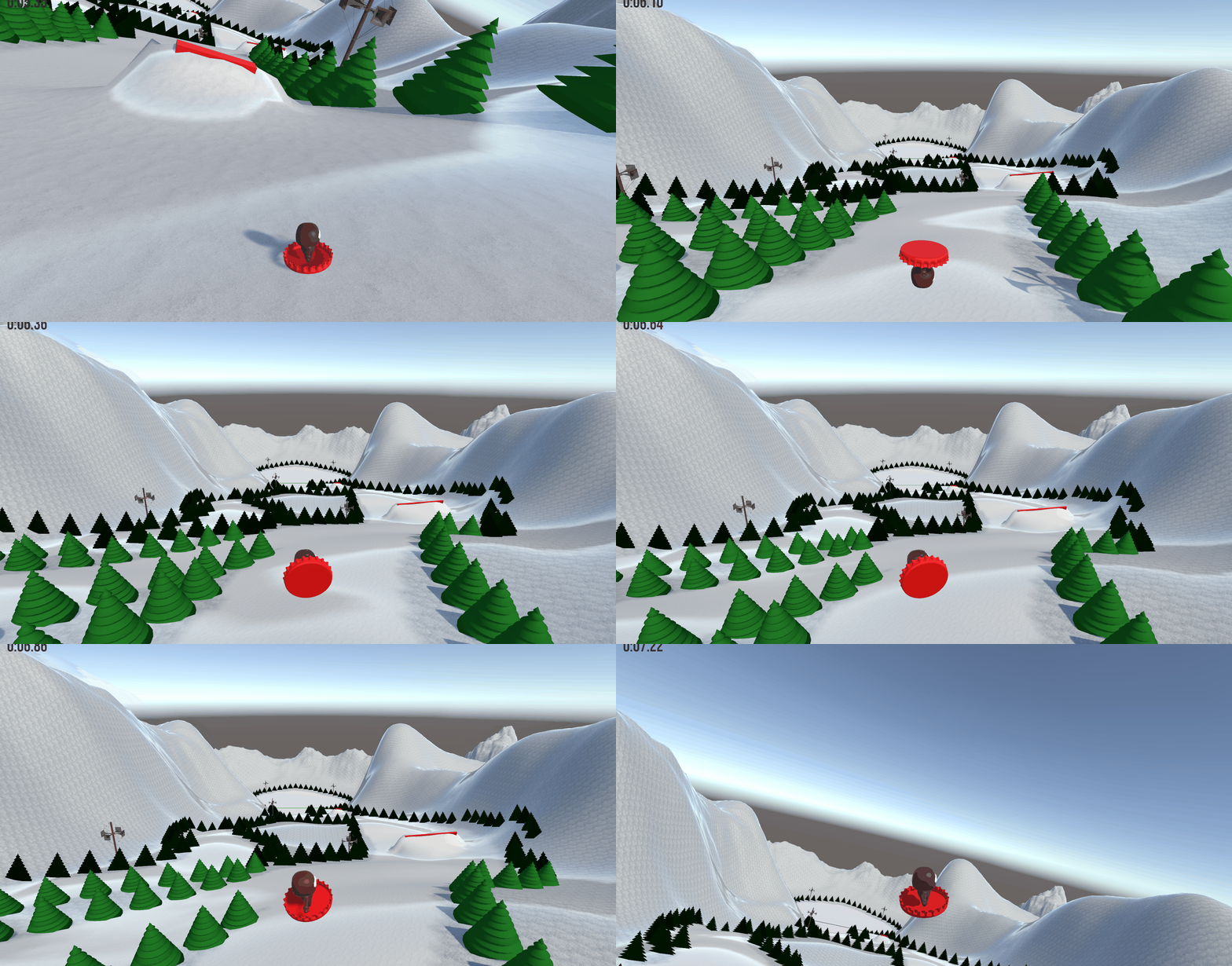
Crazy Boarding is a high-score based snowboarding game prototype, where the player controls a character using a bottle cap as a snowboard.To get points, the player must do flips and turns in the air, with full turns and flips counting for more points, and get to the finish line as quickly as possible. Once the player reaches the finish line they are presented with an ending screen, breaking down their score.The game was developed in under a week by myself for a game development class.
Cozy World
Published: Oct 03, 2023
Roles: Designer and Programmer
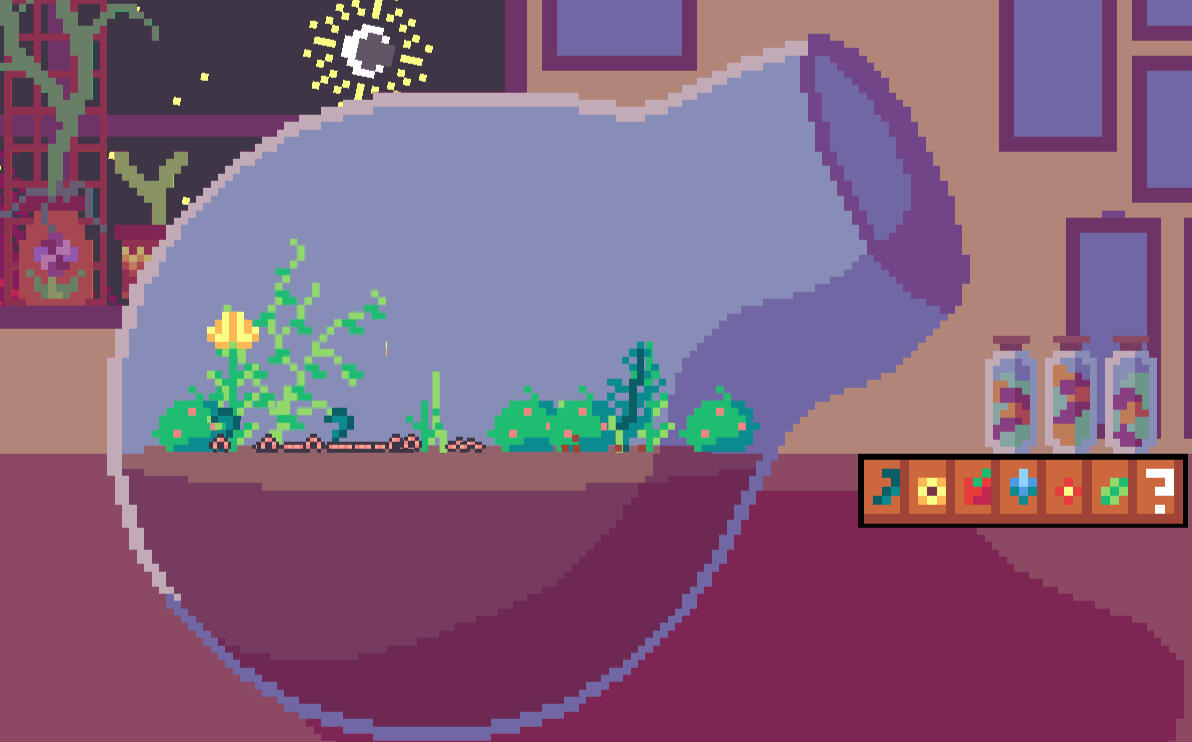
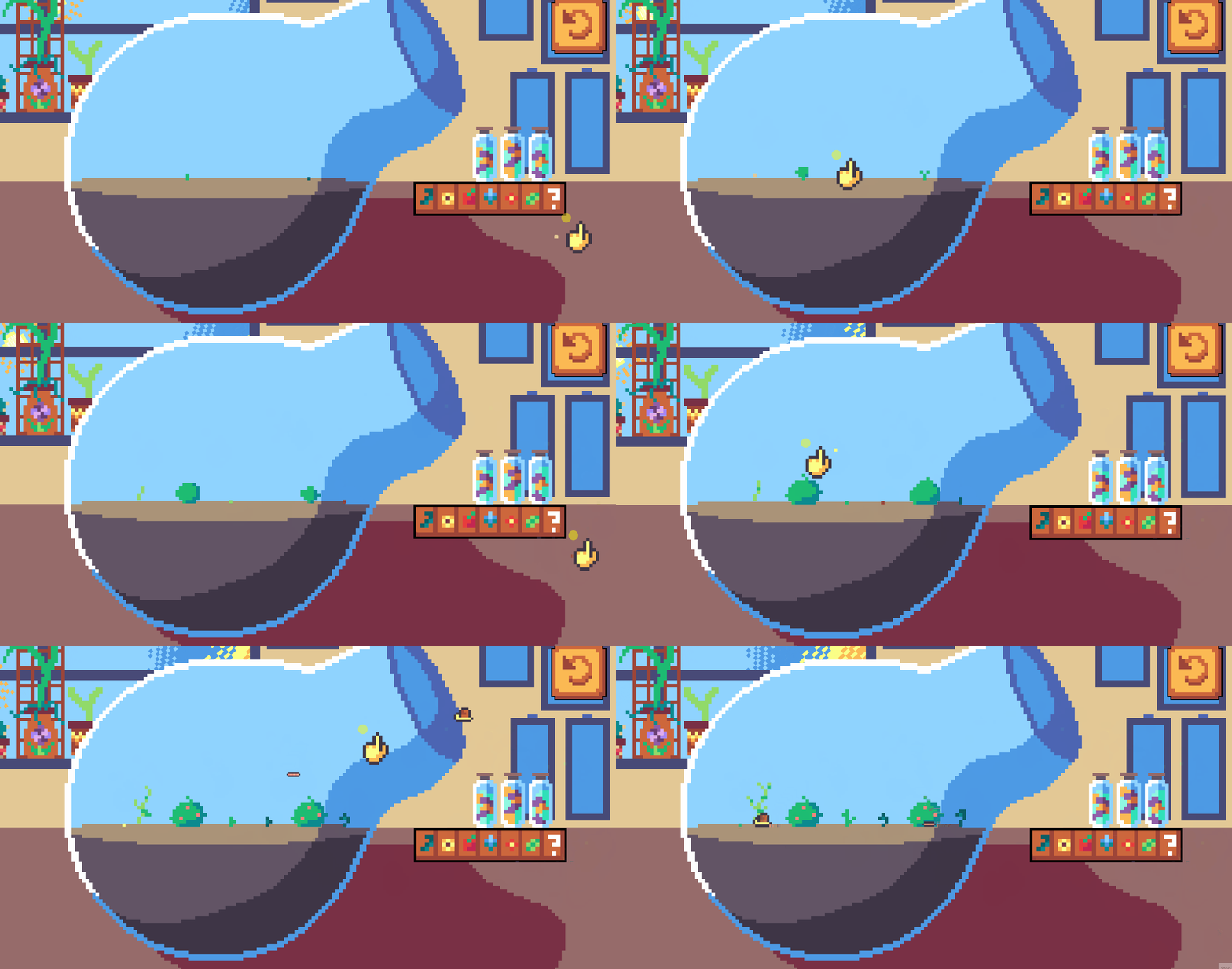
Cozy World is a simulation game developed in under 72 hours for the Ludum Dare 54 Game Jam.The game offers a relaxing experience where the player can place different kinds of seeds and bugs in a light bulb terrarium and see how the ecosystem develops as plants grow, die, and produce their own seeds.The game also features a soundtrack where different instruments come in as different kinds of seeds are planted, and switch from a day to a night version, and back to a day version, as time goes by.I contributed to the design of the game and was one of two programmers on the team.
Splendid Strangers
Grand Central Run
Finalized: May 02, 2024
Roles: Designer and Programmer
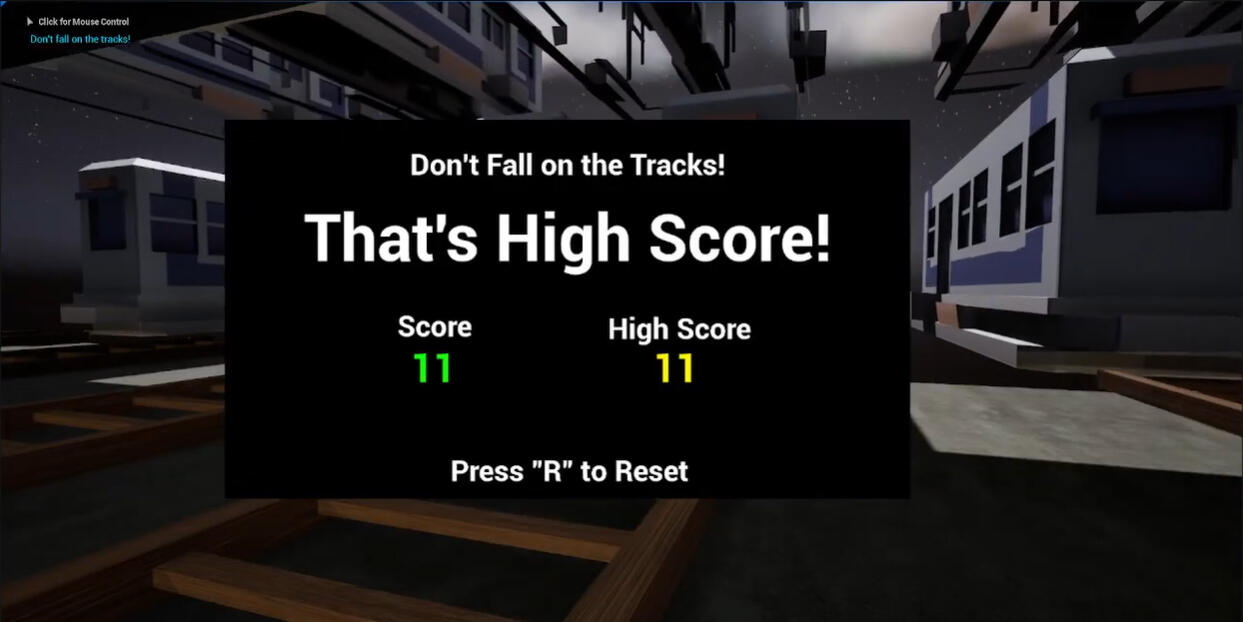
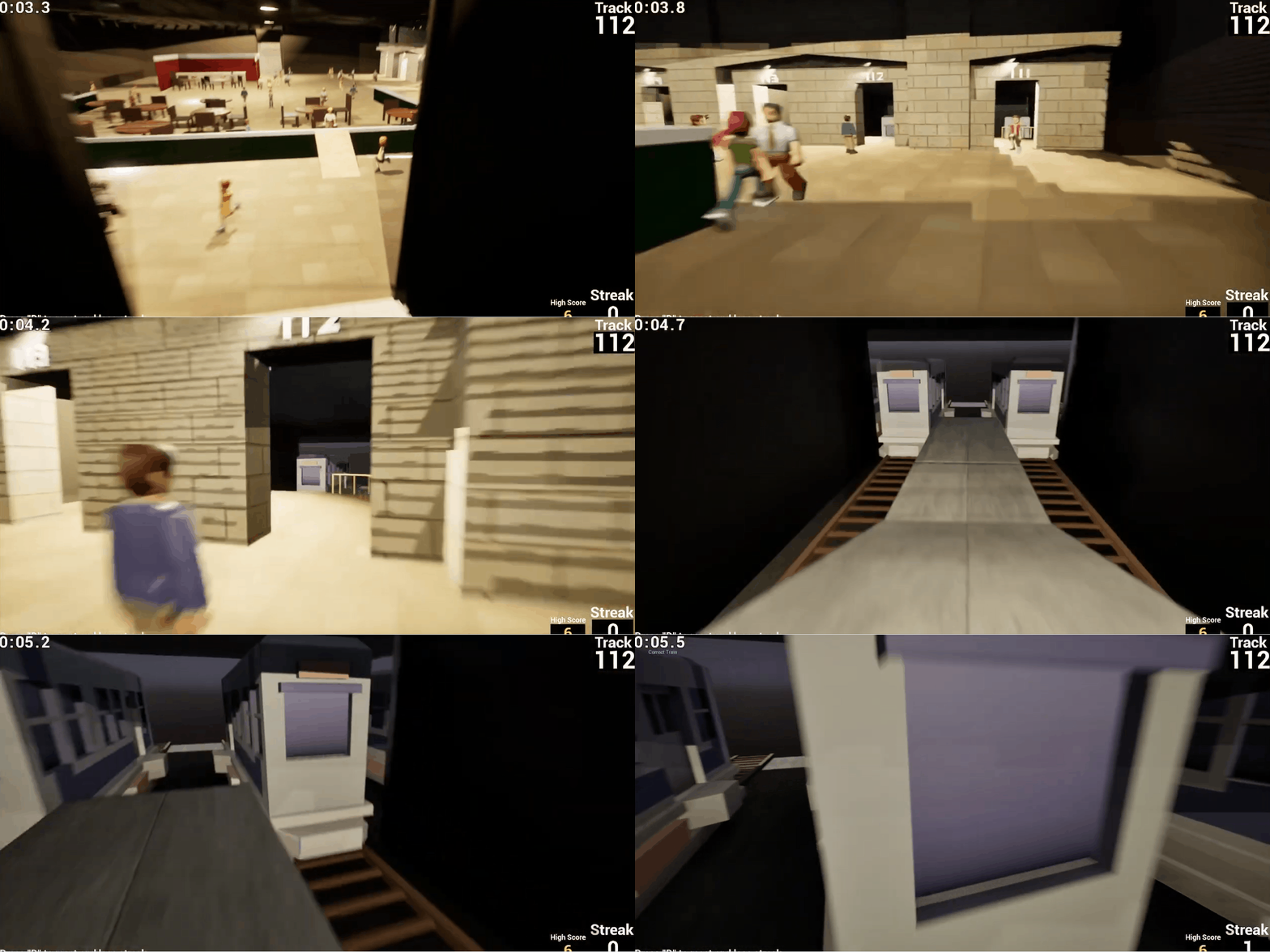
Grand Central Run is a high-score based game where the the player must run to catch their train starting from several different starting spots in the station, with every successive train they catch making the trains' speed quicker and quicker.The game was developed over the course of a handful of months, initially as a solo dev before getting help for texturing and modeling. It was made using Unreal Engine 5, and I was responsible for all of the code and design.
Sarmale
Published: December 16, 2024
Roles: Designer and Programmer
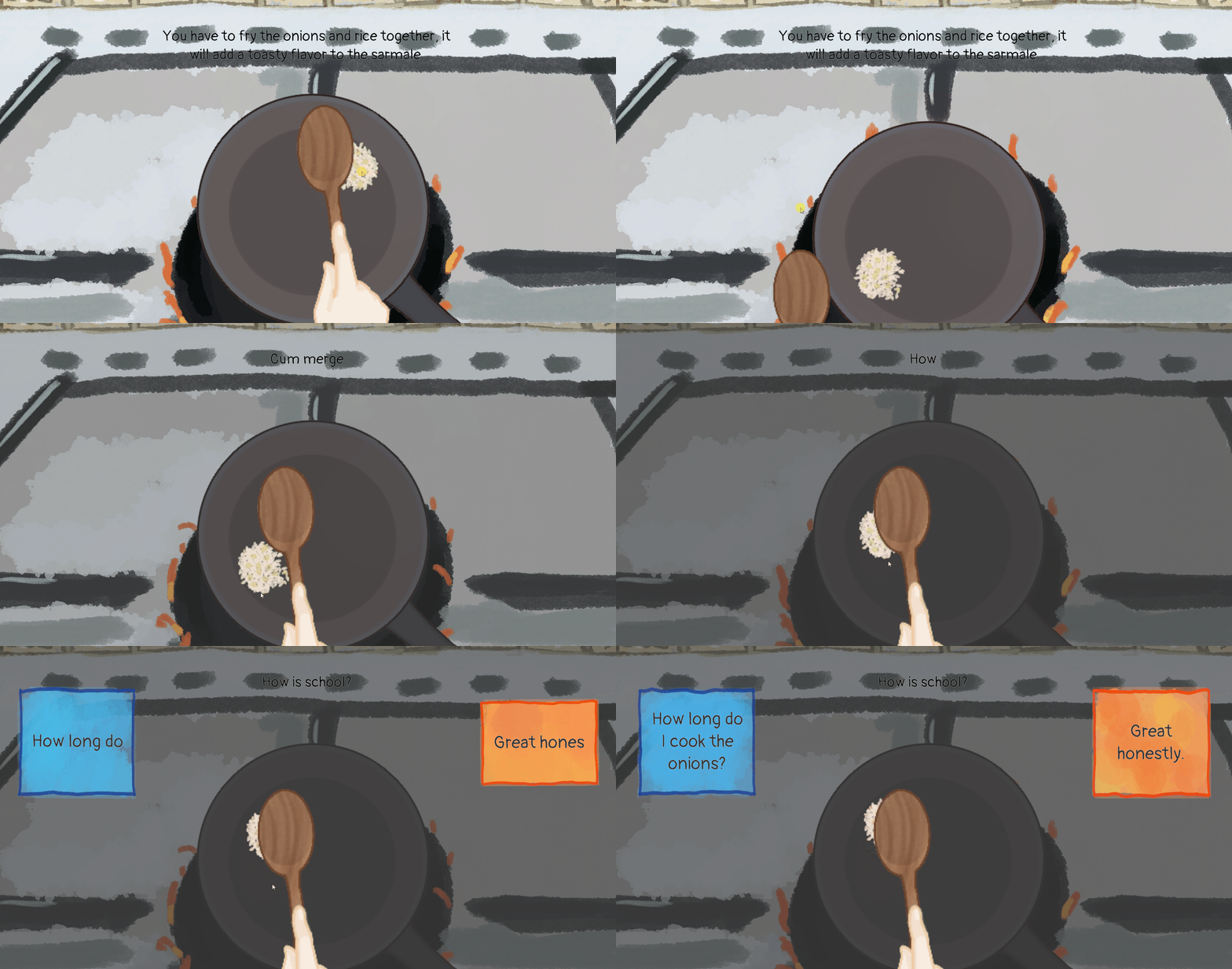
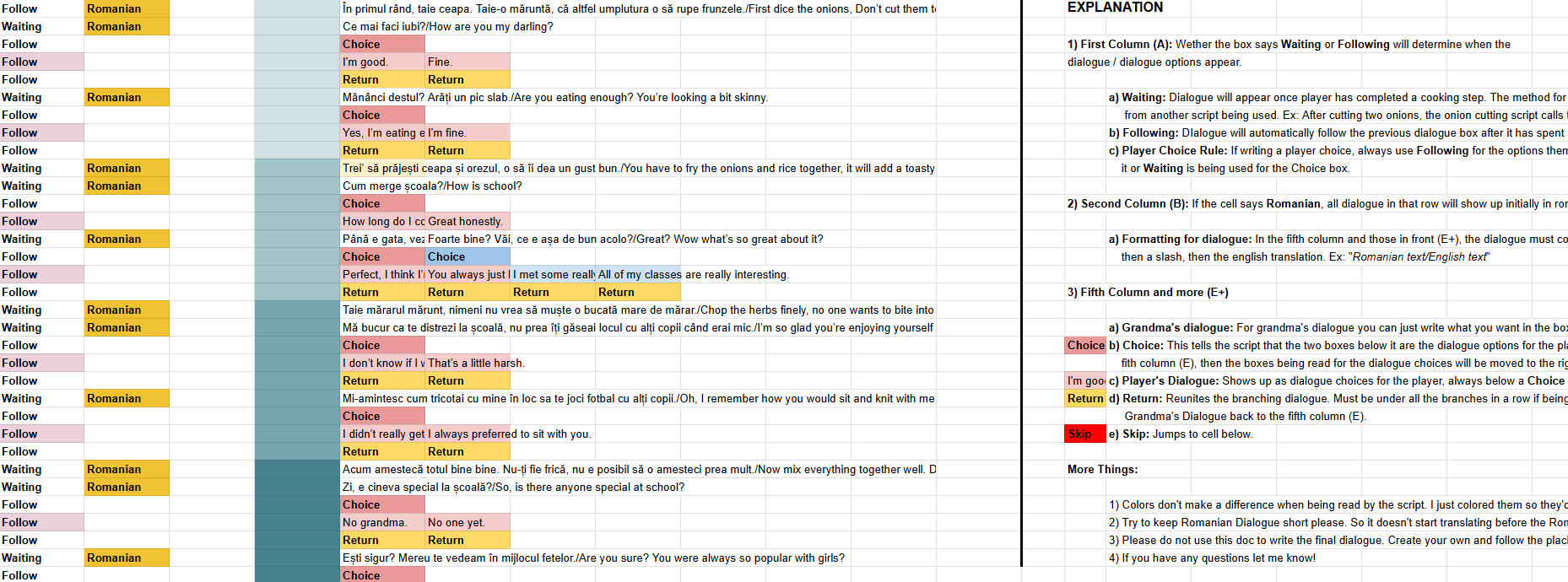
Sarmale is a short narrative cooking game about the player character's refusal to come out as gay to their grandmother, in fear of the reaction that it could receive, and the damage it could have on their relationship. The game consists of five small cooking minigames during which the player has a conversation with their grandmother, with her Romanian being translated into English.My main responsibility was the dialogue system and to make it work hand-in-hand with the cooking minigames. I did some quick experimentation with some dialogue plug-ins for Unity before creating a system from scratch, using a script to interpret what to do from a CSV file. I then created a guide sheet using some of the early dialogue the writer had made, along with explanations for how the system worked, so they could then use it themselves. We found CSV files very unreliable in some ways, but after some concessions on complexity, the resulting system did exactly what we needed it to.Click on the Dialogue Sheet to get a better look!
Splendid Strangers

Cooking GIF

Dialogue Sheet
DJriving
Published: December 11, 2024
Roles: Designer and Programmer
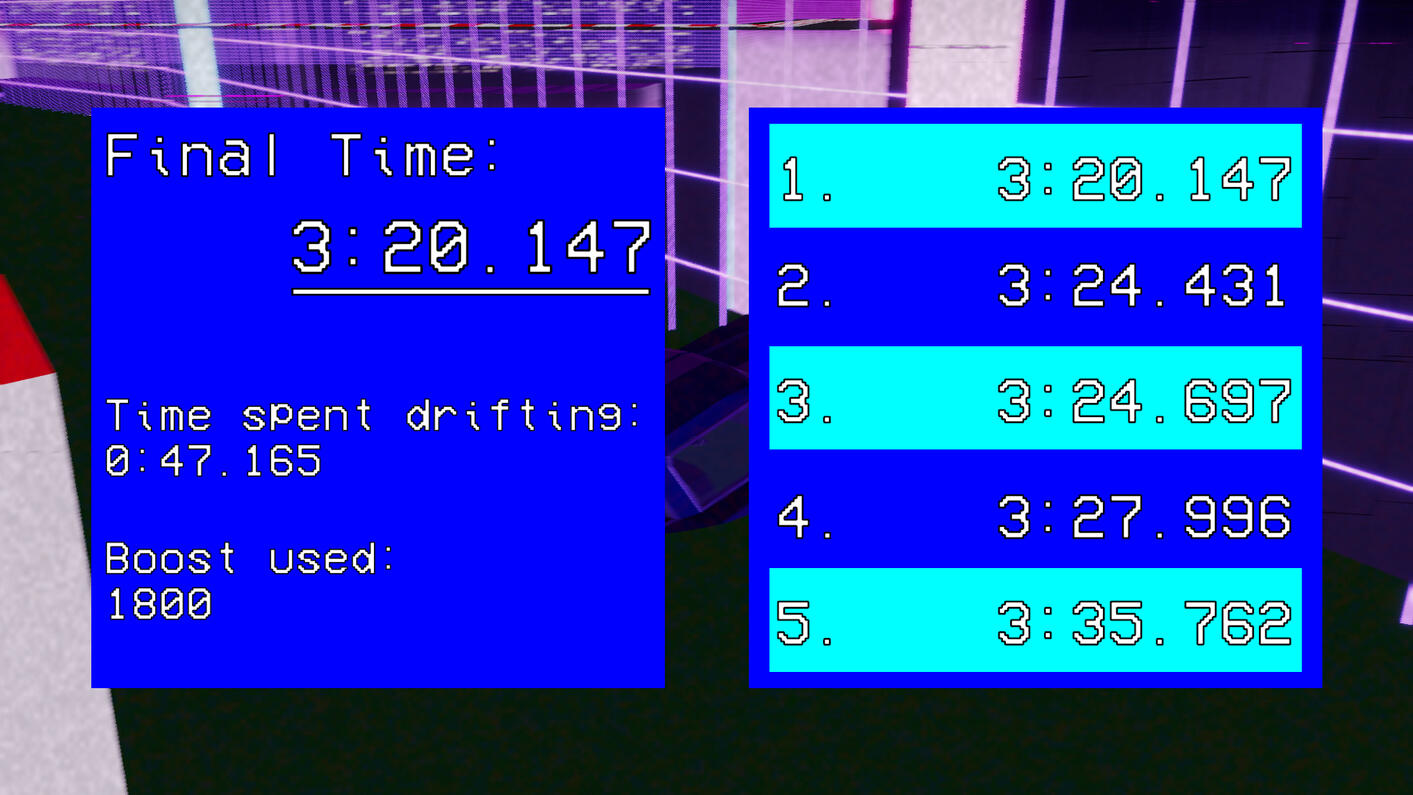
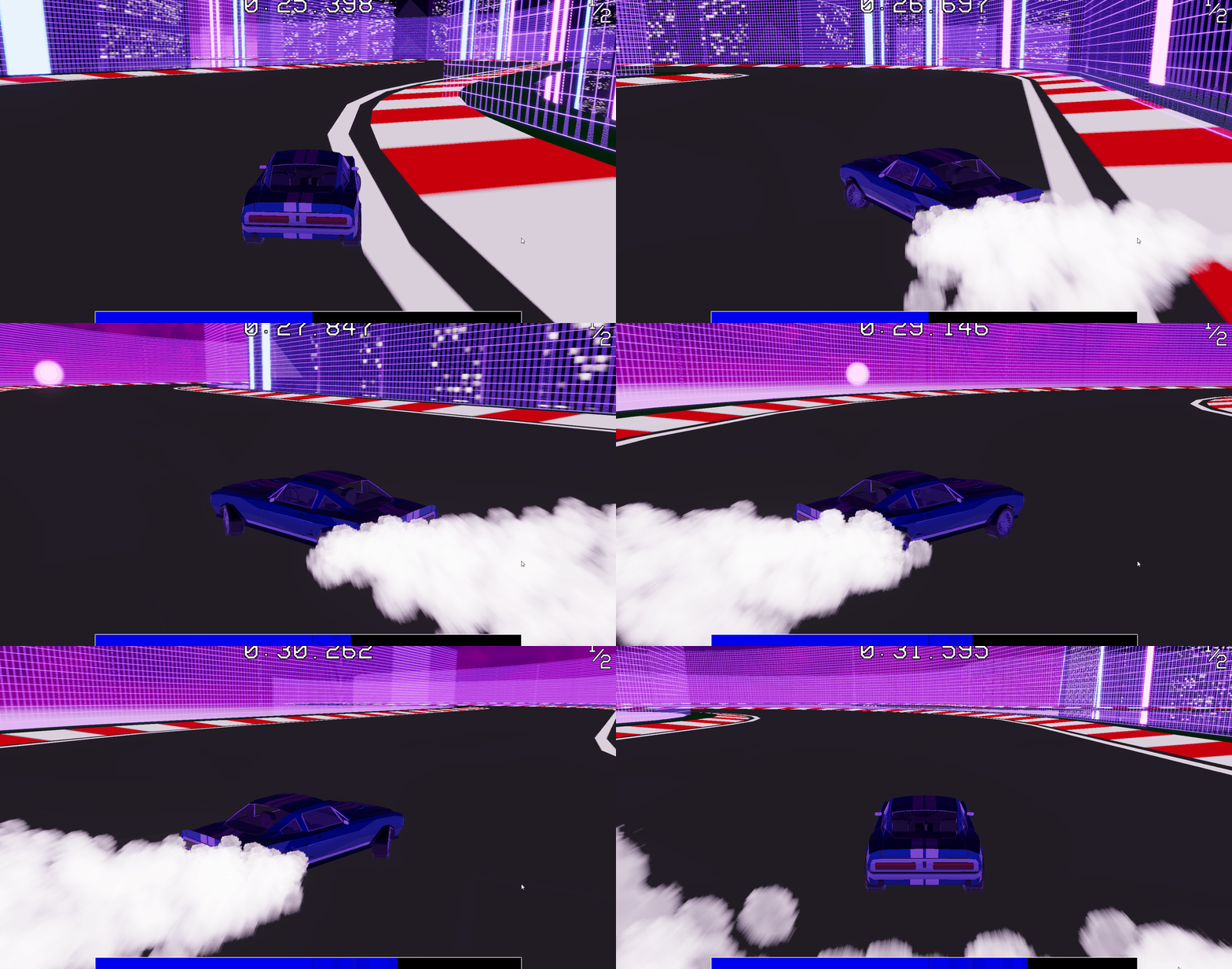
DJriving is a 3D racing game with synthwave aesthetics and a breakcore soundtrack. The player must use the car's drifting and boost capabilities to achieve as good a time as possible as the music responds to the player's racing.I was part of a team of 4 and was the main programmer for the project while contributing to the design, with the drift mechanic in particular being something I spent a lot of time iterating on to achieve as good a game feel as possible.We spent a lot of time as a team iterating on different ideas for movement and audio interaction with the controls. We landed on a set-up that is relatively similar to traditional racing games, but still encourages heavy use of the drift mechanic to achieve as good a time as possible.
Splendid Strangers
Volt Games
Period: May2024 - Aug 2024
Role: Game Design Intern
Over the course of three months I worked as a part of the Volt Games design team and contributed to multiple mobile games' design and testing.I was the lead level designer for multiple hypercasual mobile games (Flip Cubes!, Serve Away!) some of which were not released, and also designed tutorials for them.I worked on two mobile sports games, one of which has not been released yet, and the other has an early build available for testing. I contributed to gameplay design, the design of the leaderboard system, game progression, First-Time user experience, and U.I.Click on the U.I. wireframe and Design Doc to see more.
_Splendid

Flip Cubes!

Golf Stars!

Serve Away!

Map designed for Golf Stars!

U.I. for Golf Stars!

Design Document for Golf Stars!
Heart and Mind
Published: May 15, 2025
Roles: Designer and Programmer
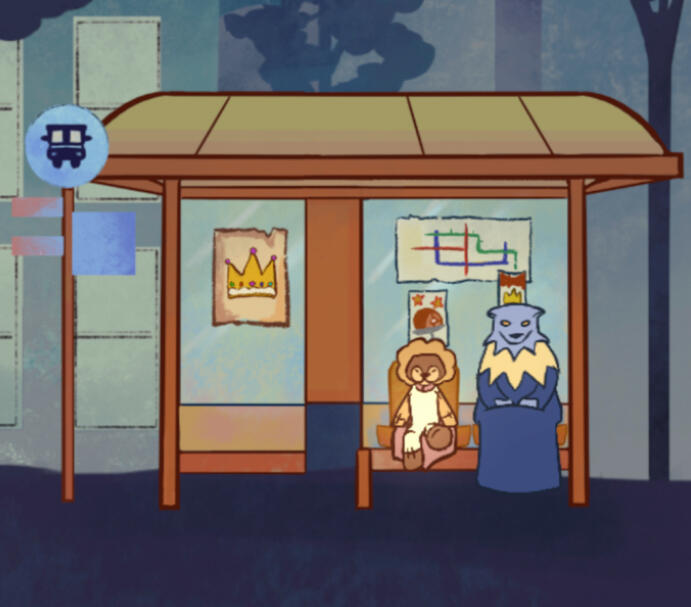
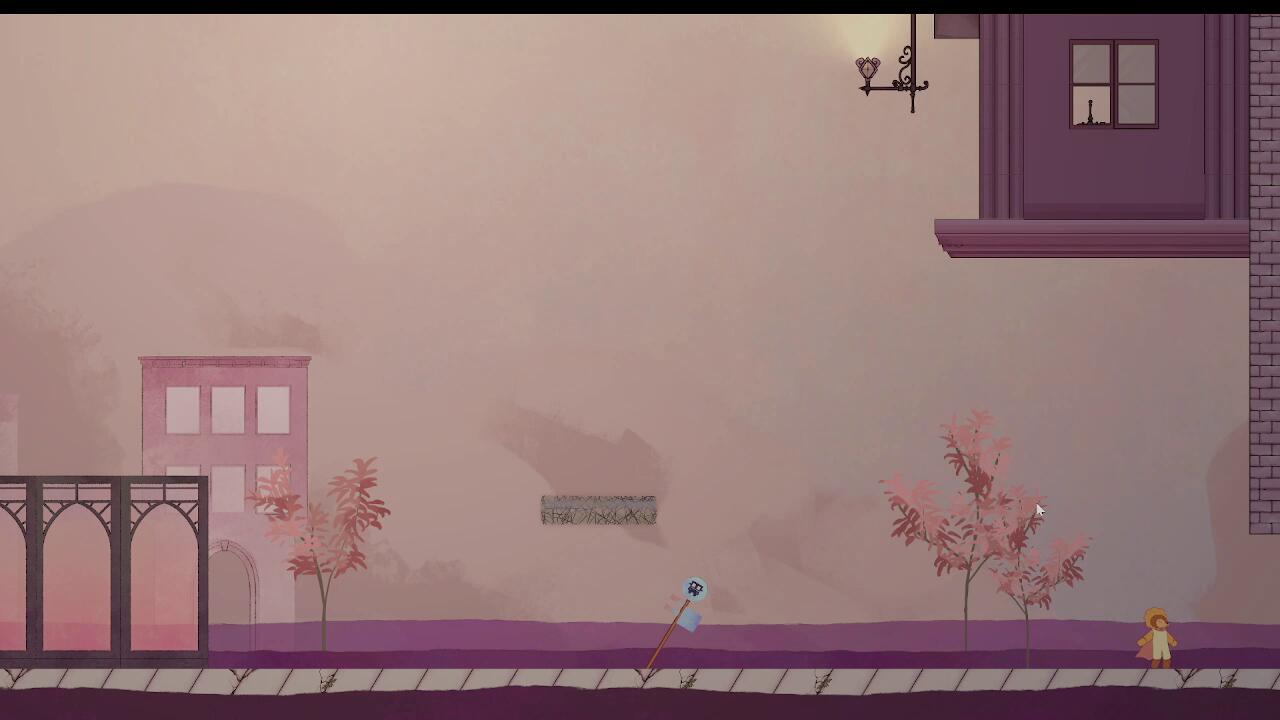
Heart and Mind is a narrative puzzle platformer, where the player takes control over a character's Heart and Mind, personified in the form of a cat and wolf. This is a reinterpretation of the original Heart & Mind, where I worked with a smaller team and on a smaller time scale.I served as one of the lead programmers and level designers in the project, but also assisted with production, and contributed to other areas of design. The game has a 3 act structure, with levels in which the player plays as both characters simultaneously, and some where they only have access to one of them.
,

Level Design
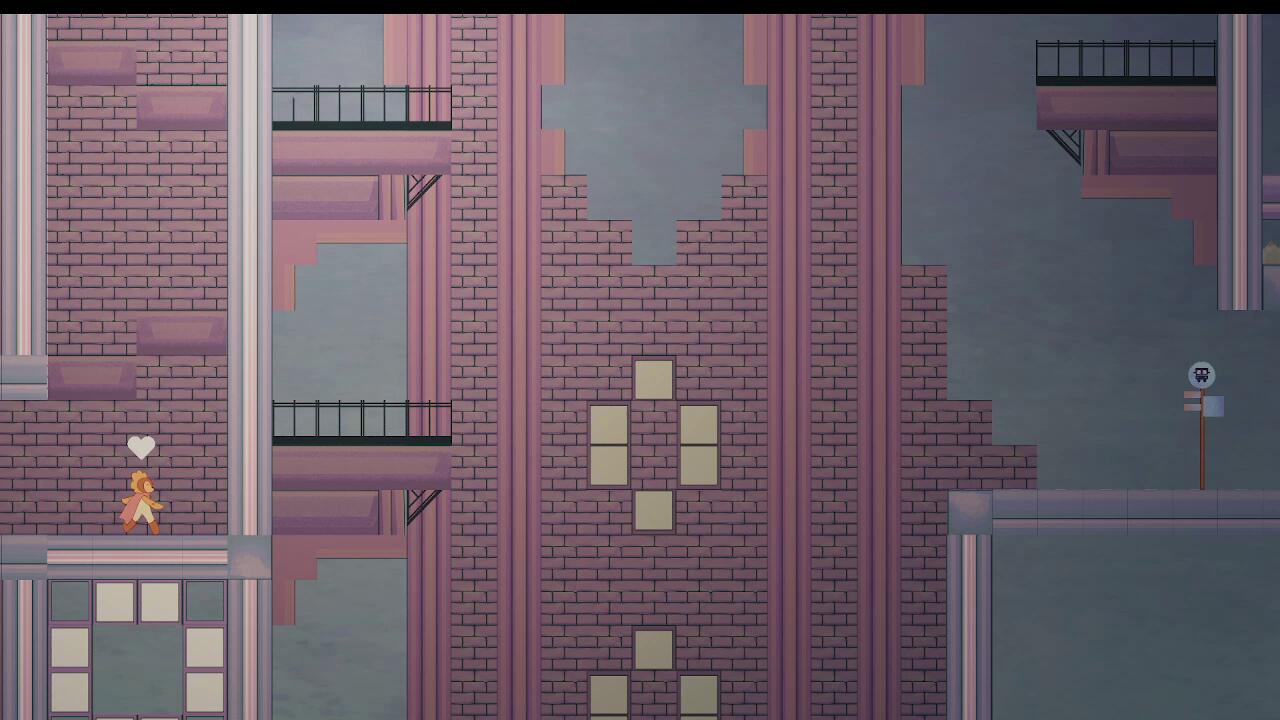
I was responsible for the level design for the Mind sections, which focus exclusively on puzzle solving over platforming challenges, and the latter half of Act 3, the hardest levels to complete for the player, where they need to use both the Mind's puzzle solving and the Heart's platforming in quick succession.Both sets of rooms were initially sketched out in-engine with basic blocks, starting with an initial concept, such as having to catch blocks mid-fall and pushing up light blocks when they are on the character's head head, and then developed with heavy playtesting.In the video on the left the player is forced to quickly alternate between Heart and Mind in a speed that they never hadn't been forced to before.
Level Design
Heart's Movement
Coding and designing the movement for the characters was by far the most challenging part of development for me. Initially both Heart and Mind could move freely around the level (the second GIF is of Mind with an early version of its block moving ability), but even after settling on only Heart being able to move around, it was still a big challenge to get the right level of sensitivity, weight, and responsiveness for the game.In the end Heart was able to walk, jump, wall jump, wall slide, and has a dash that can break through grass walls, which recharges when the player lands back on the floor.
Total 11
Current Stage: In Early Development
Roles: Solo Developer
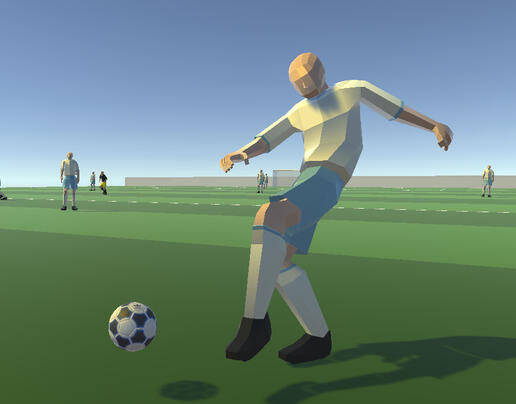
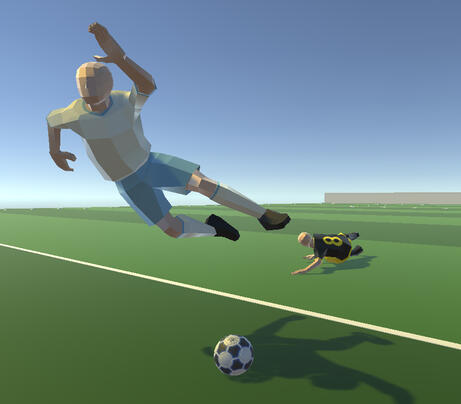
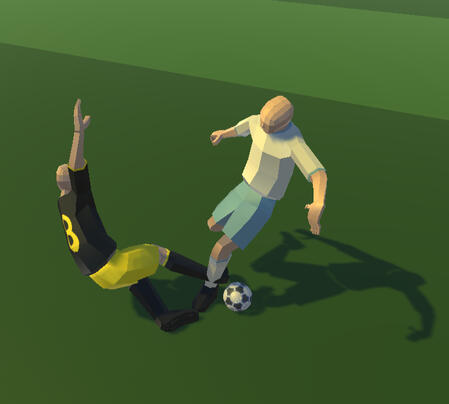
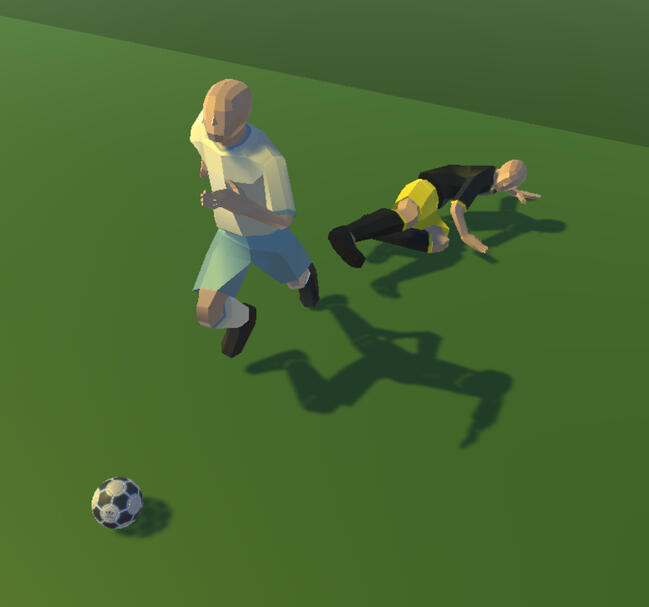
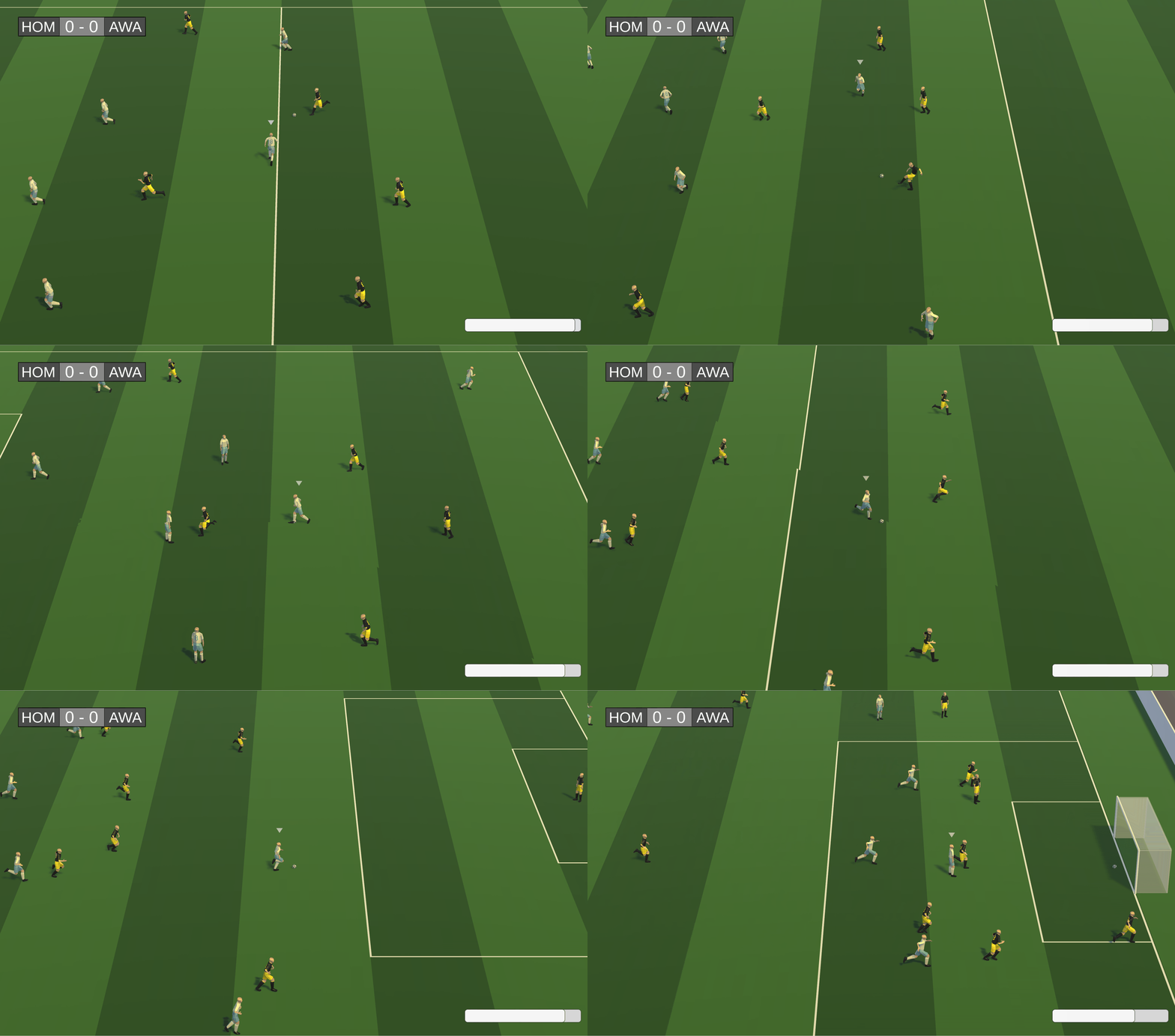
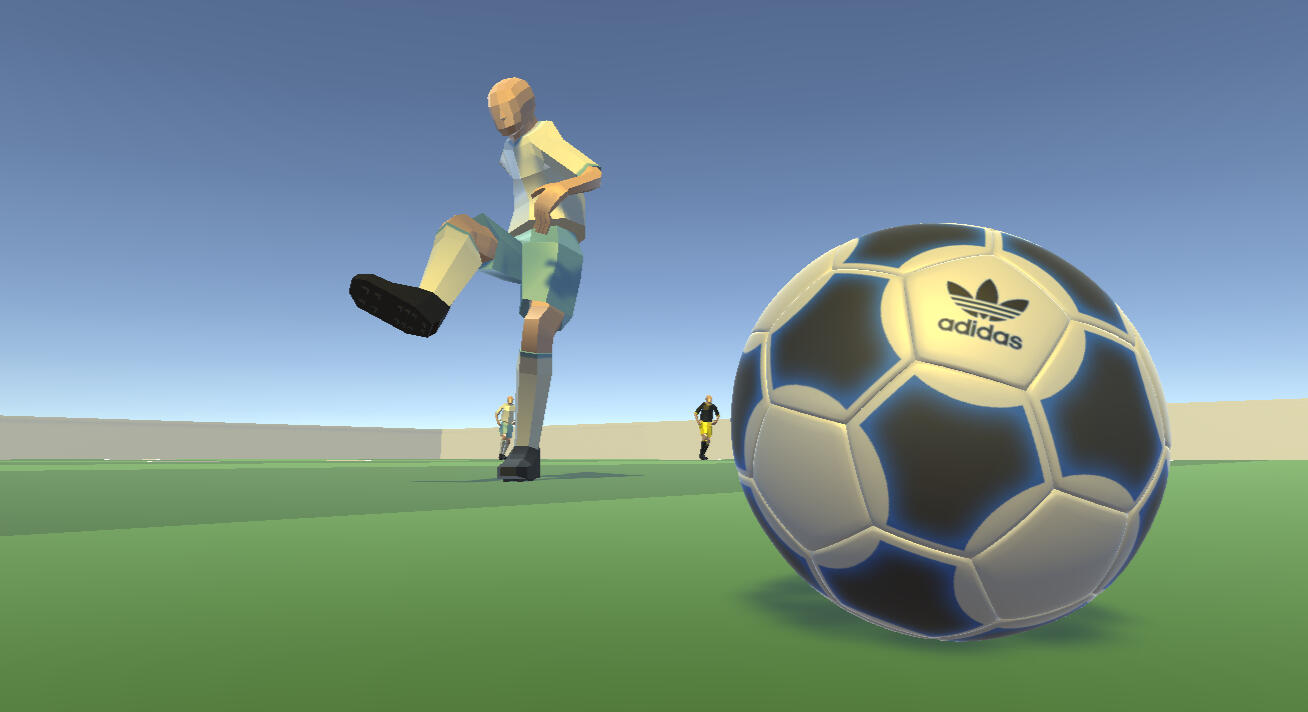
Total 11 is a footbal game with RPG relationship mechanics that is in still early in development. The player takes on the role a coach that is hired by a team in a fictional version of the English league, and the game takes place through the course of their season. The in-match gameplay is relatively similar to other soccer simulation games, taking inspiration from Pro Evolution Soccer 6 in particular, but will integrate with special skills and bonuses that can be gained in the out-of-match relationship mechanics, which take inspiration from the Fire Emblem Three Houses system. The game also takes inspiration from previous soccer RPGs, such as the Captain Tsubasa and Inazuma Eleven series.The main focus so far in development has been creating the in-match gameplay, with basic functionality for passing, shooting, and tackling being implemented, and player A.I. for both teammates and opponents being worked on at the time of writing this. Click here to read about the design and development of the football gameplay. Some work has also been done on creating the characters, the different fictional teams that populate the league, and writing the greater story as well as the smaller story arcs for the different character connections.
,
Dreamscape
Release Date: May, 2026
Roles: Designer and Programmer
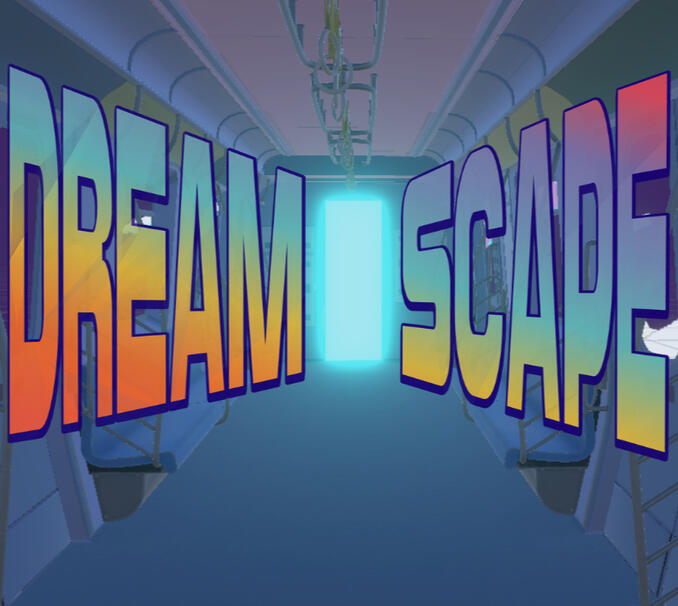
Dreamscape is a puzzle game being developed by myself with Mushroom Kosztolányi, Kimya Taheri, and Jingxing Xu. In the game the player must complete word puzzles to manipulate the different dreams they visit and uncover the dreamer's history.I am serving as one of the lead programmers and narrative designers in the project, but have also contributed to level design and system design, as well as some limited 3D modeling. The game can take from 2-3 hours to complete, was developed in under a year, was exhibited at GDC 2026, and is planned for a Steam release on May 2026 (wishlist us there!).
,

The Narrative
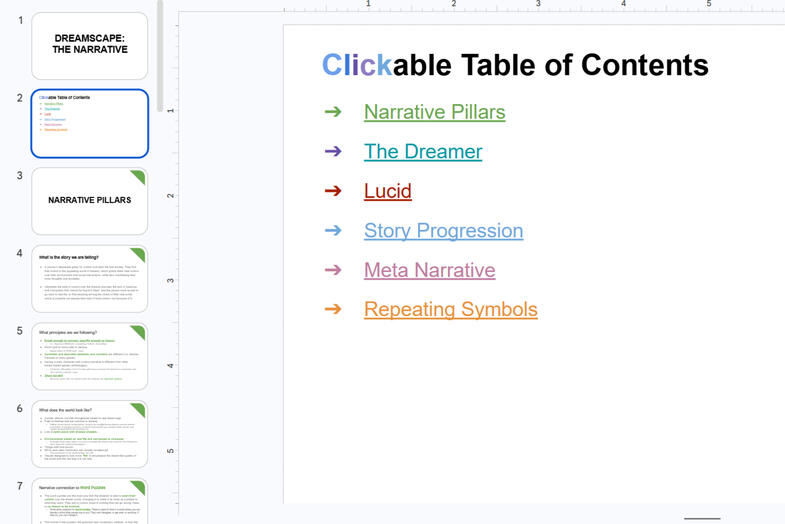
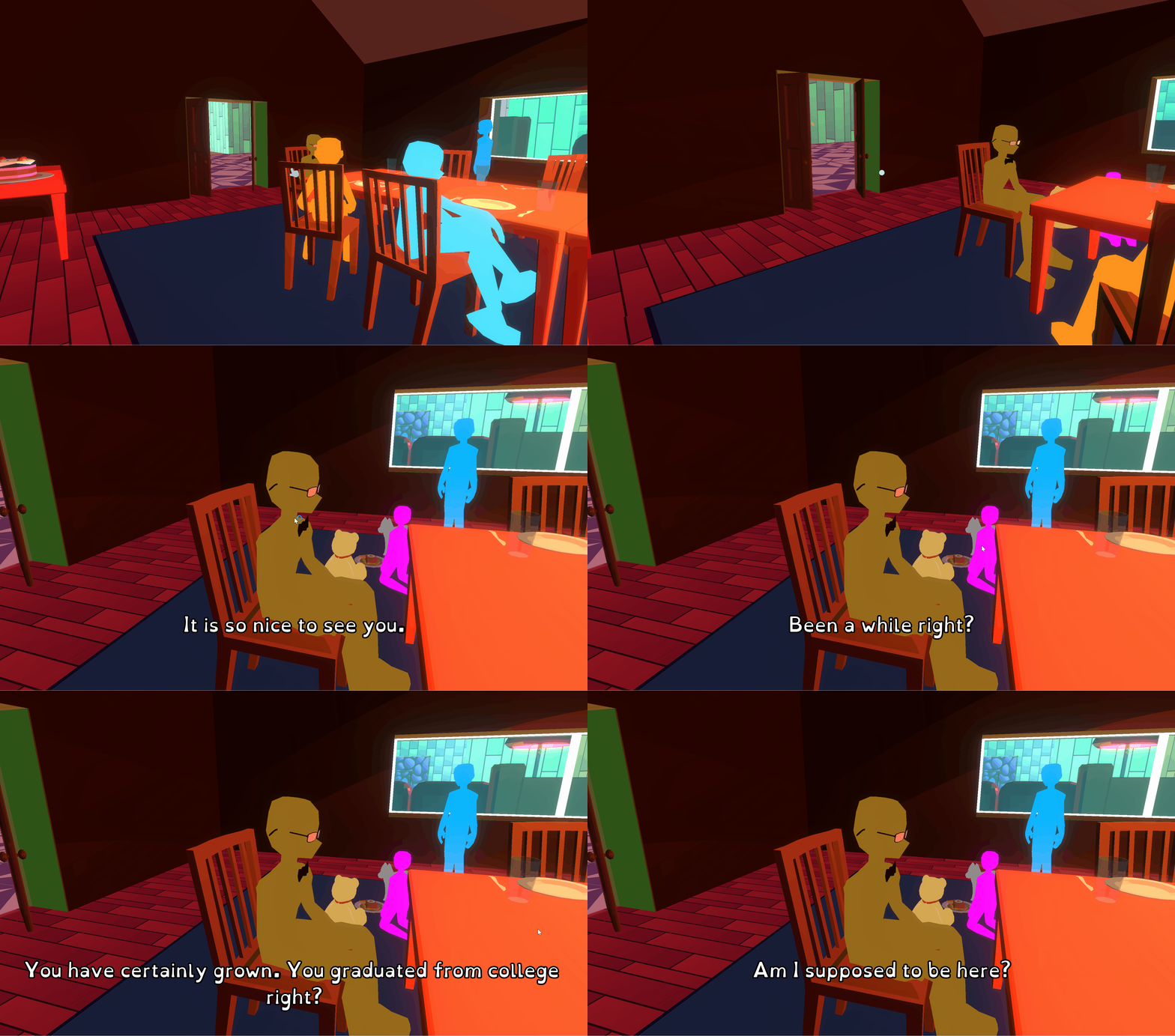
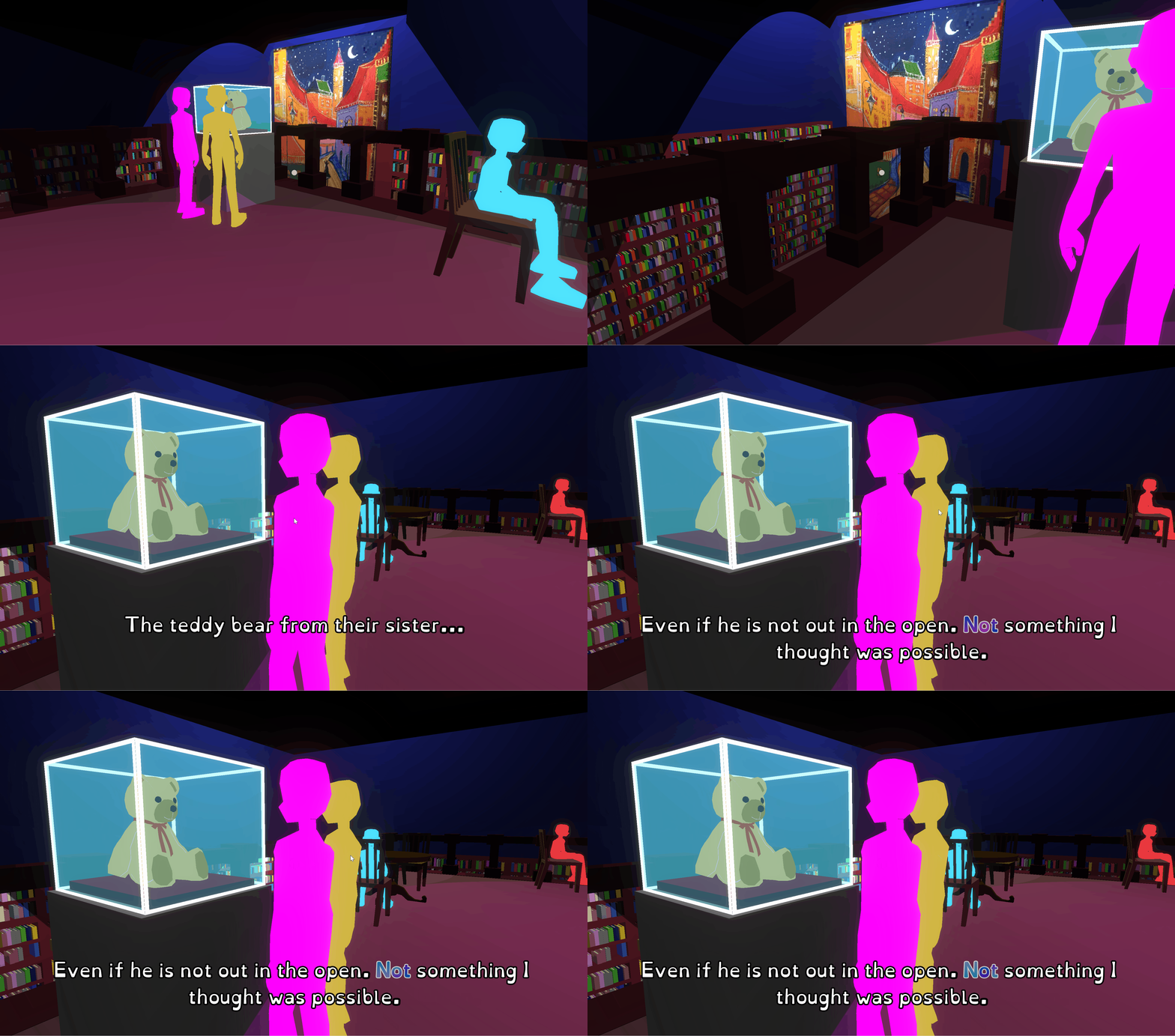
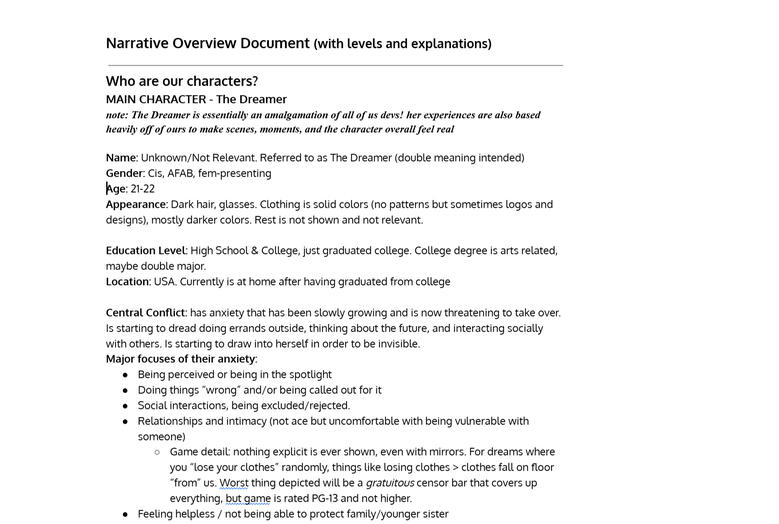
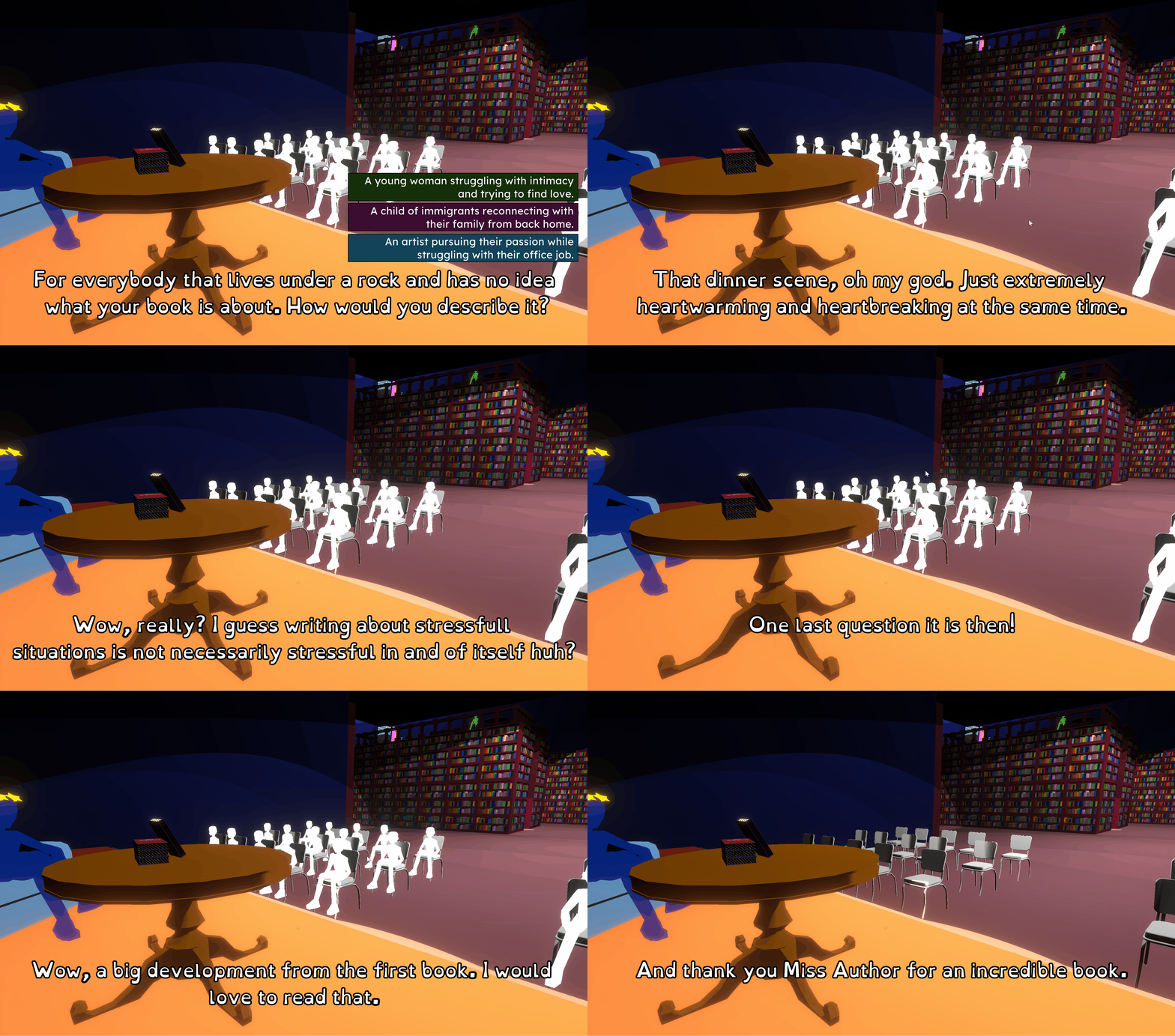
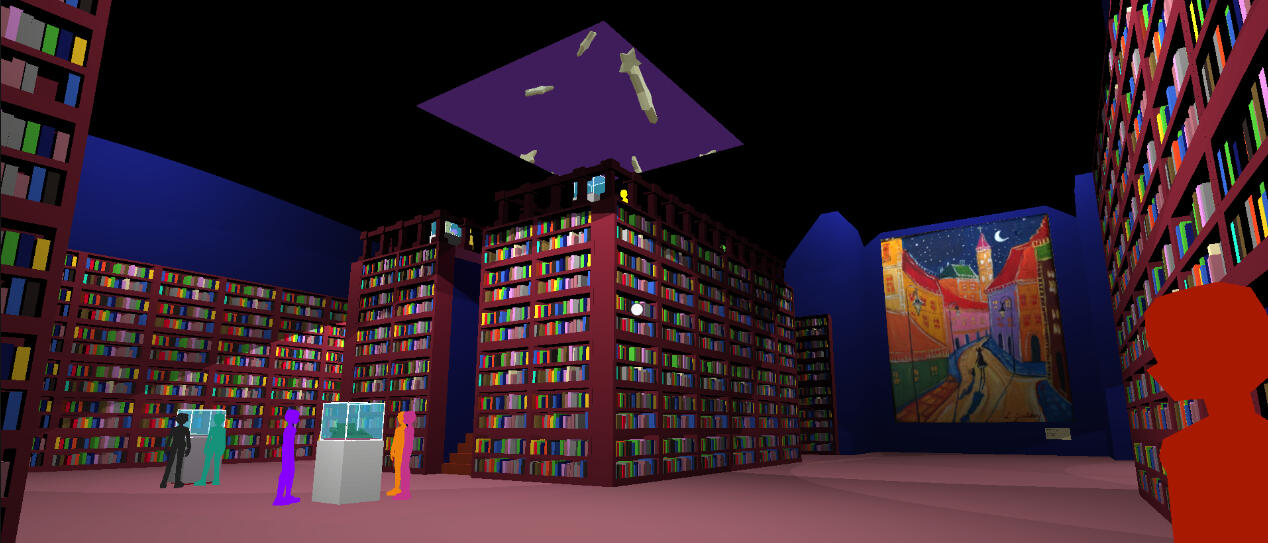
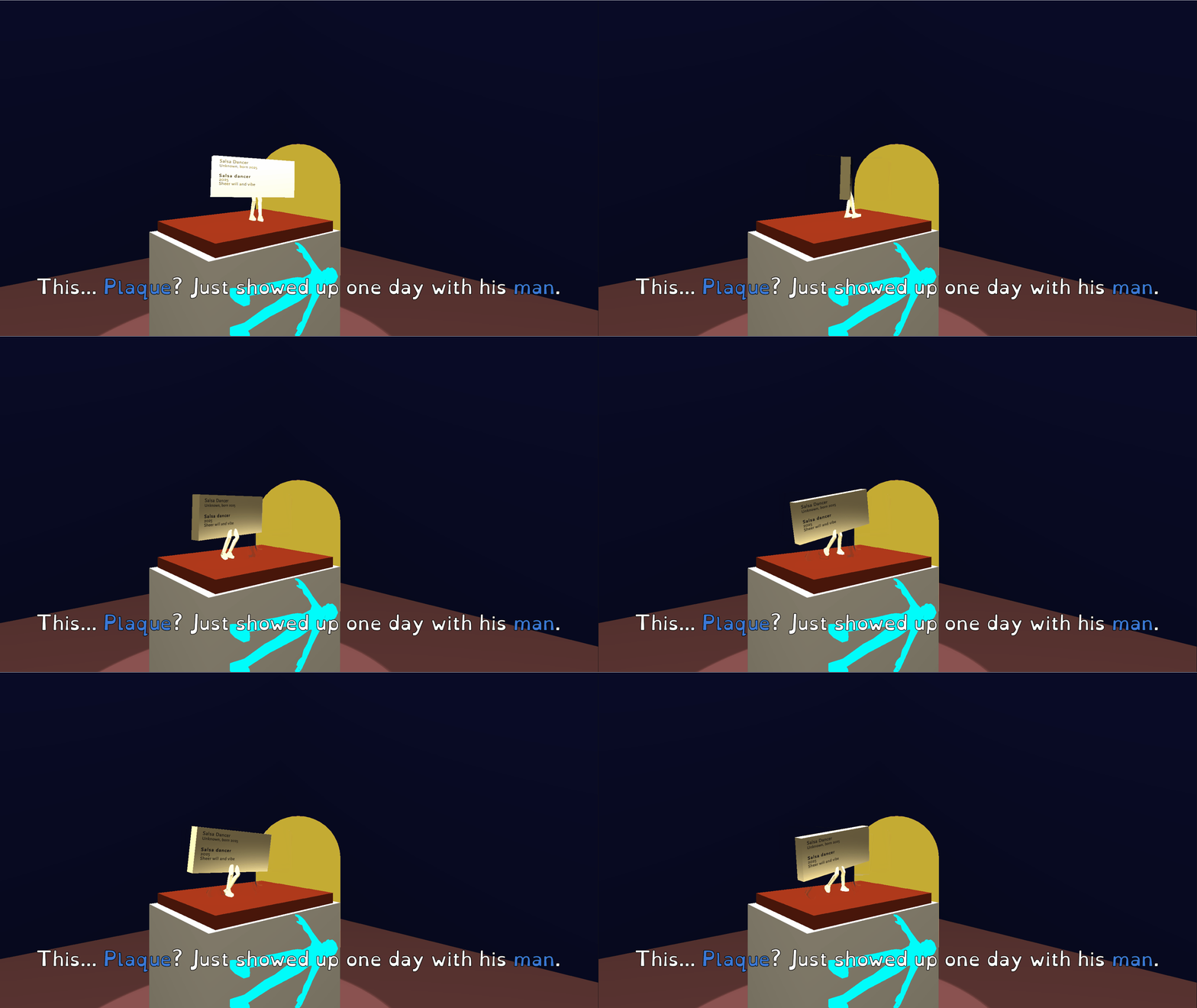
Dreamscape is a game about a young woman being trapped in her dreams, and despite the sense of control that her dreams give her over her anxiety, how she must learn to let go and accept the real world so she can wake back up.There was an initial narrative overview document in a Google Doc, but I later shaped the narrative work that we had done into a new document in Google Slides. The new document reworked the main character into a writer, more explicitly connecting her history to the main mechanic, changed details about the levels to better fit the character's history and the game's themes, and more.The first level in particular saw heavy revisions, changing from a museum that showcased items relevant to the character's past, to an exhibition and book tour interview in a library, making the connection to the story more explicit.
Level Design
Dialogue Puzzle Systen
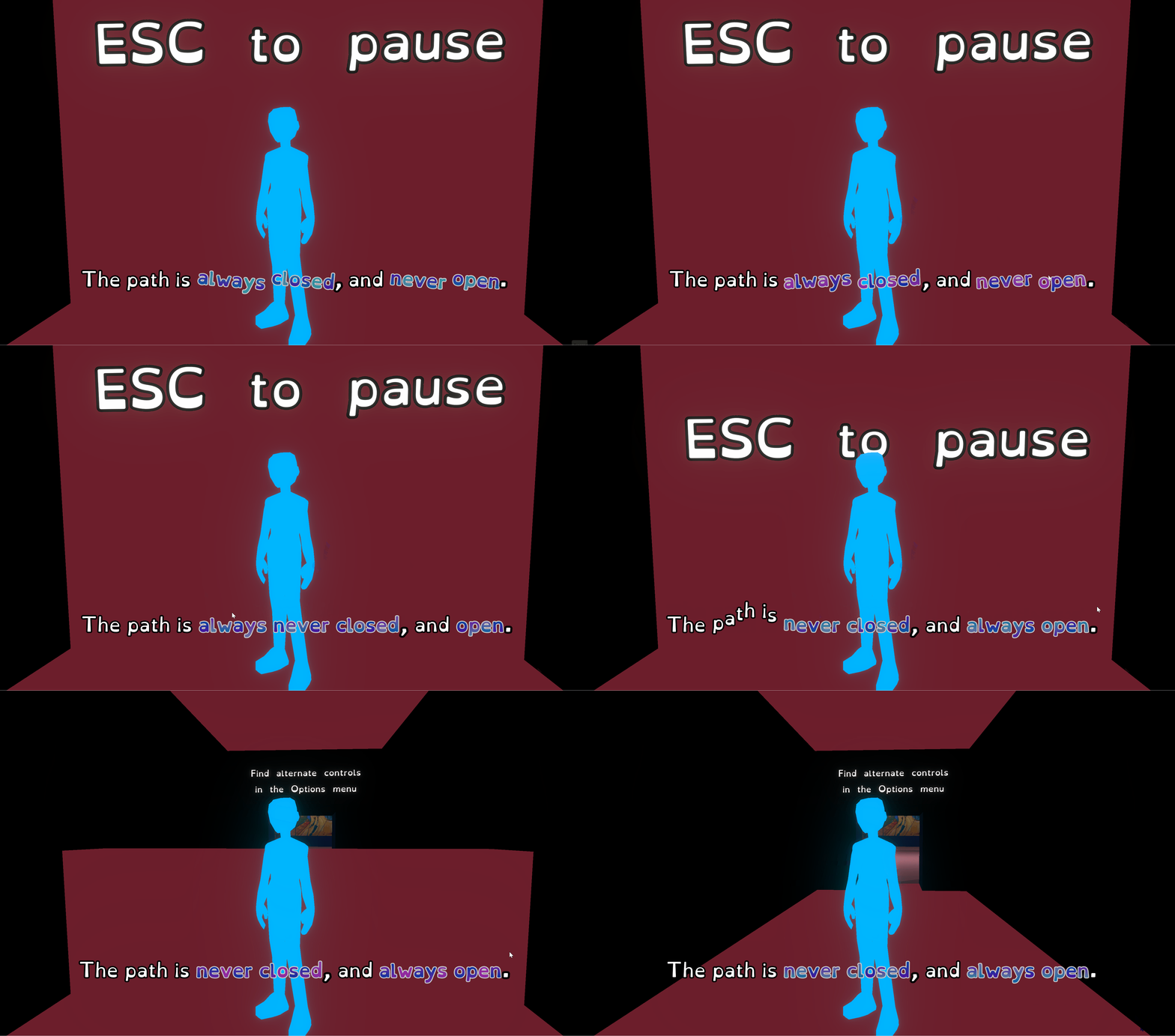
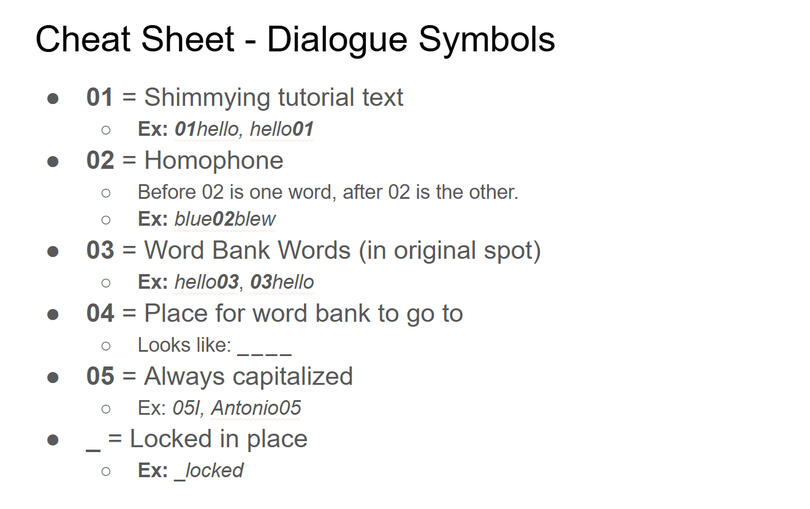
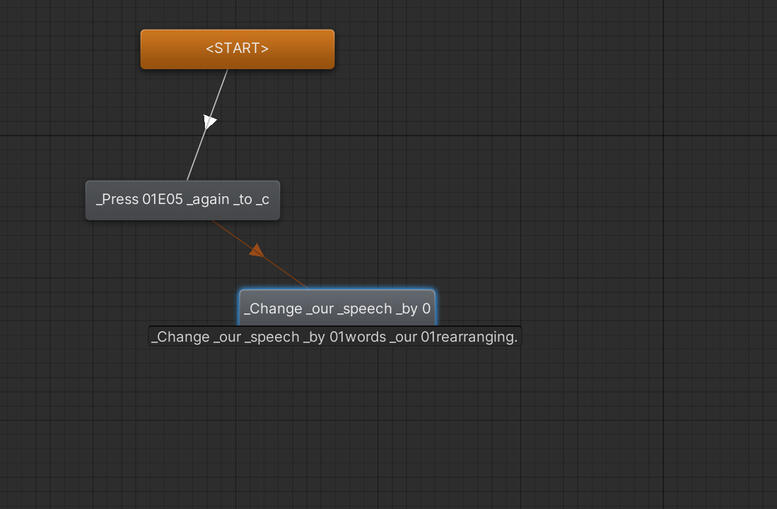
The main mechanic in Dreamscape are the word puzzles. The player can use their mouse to move around certain words in the sentence to form new meaning, which forces the dreams to change. I am entirely responsible for the dialogue system, which I created using Pixel Crusher's Unity Dialogue System as a base, primarily for the dialogue tree editing functionality.The system supports dynamically changing capital letters, "homophone words" that change from one word to another, and special "word bank" words that can be removed from their original sentences and inserted somehwere else.Developers can initially add new dialogue entries to the database, creating them as nodes in a dialogue tree. Then those dialogue entries can be accessed by objects in scenes with a Dialogue script, which can hold multiple different dialogue entires, alternate solutions for puzzles, and a method that is accessed when the puzzle is solved. Click here to read more about the dialogue system's design and development.
Level Design
Level Design
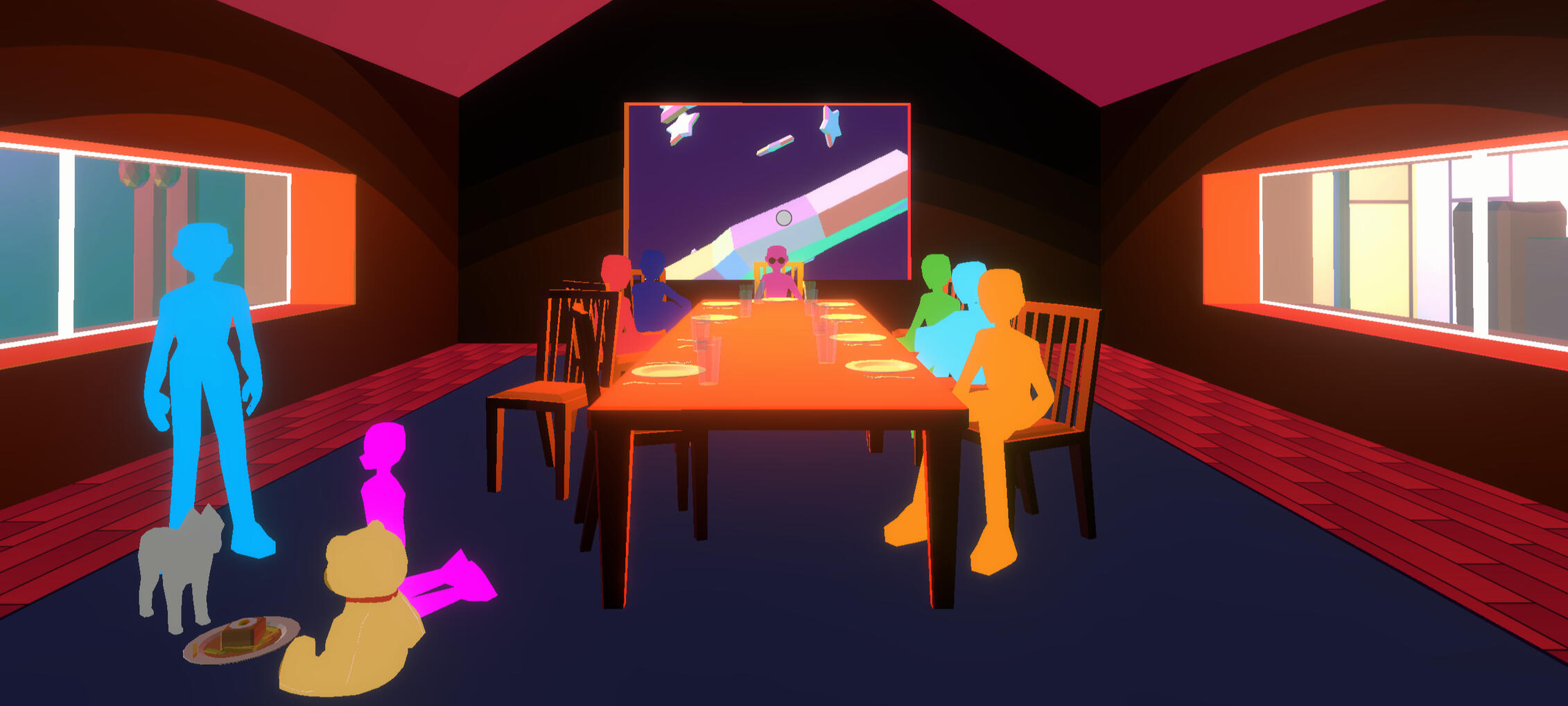
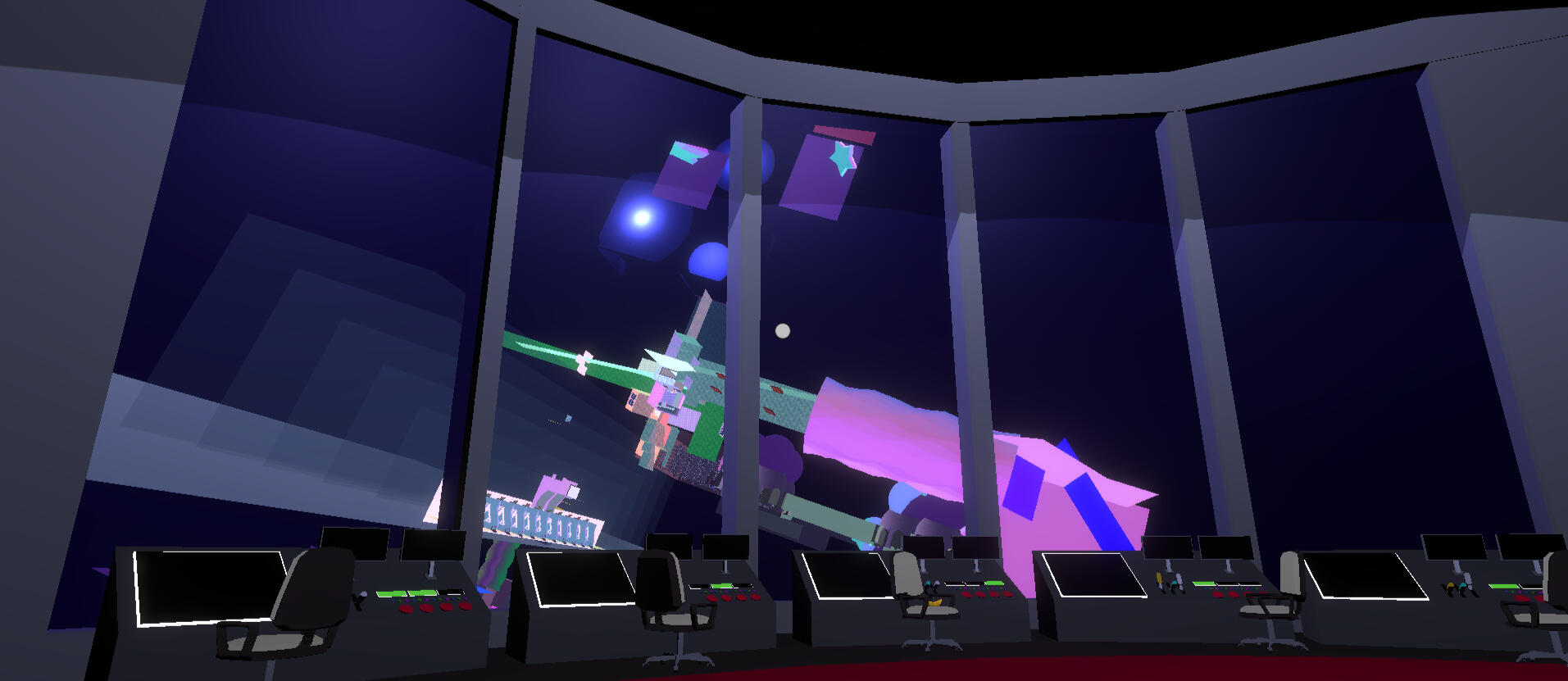
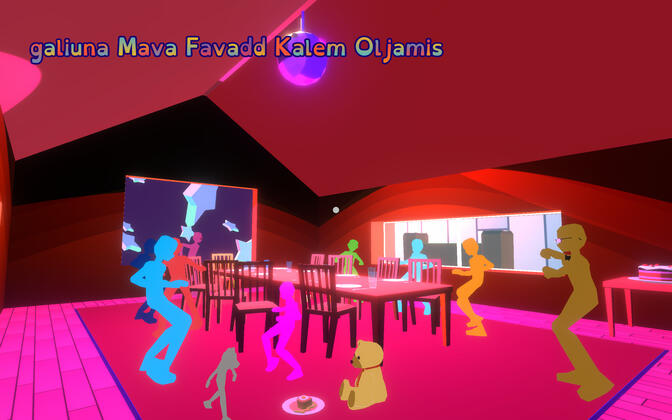
I was in big part responsible for the development and design of Chapters 1, 2 and 5. In these 3 different levels I tried to challenge the player in different ways, introducing new mechanics and using old mechanics in ways they hadn't seen before.Chapter 1 serves in big part as an the introduction to the game. The mechanics are at its most basic here, asking the player to solve word puzzles at their own pace with no special words such as homophones and word bank words. The chapter also foreshadows all the following chapters in its dialogue and environment. You can read more about my design process and development of Chapter 1 by clicking here.Chapter 4 takes full advantage of the word bank mechanic, and slows down the pace by making the player try to figure out the meaning of words in a made up language through trial and error experimentation. The fun of the level emerges through unexpected combinations, such as accidentally turning your grandmother into a furry and making her dance. The magic lies in this being just as useful as it is humorous, as it points the player towards what the words they are using could mean, getting them closer to solving the puzzle.Chapter 5 takes all the mechanics and themes that were explored in the previous levels and puts the player to the test. In this level the player finds themself in a control tower overseeing the entire dream world, and being able to access 4 different small dreams, all of which are missing something. The player must use all of the mechanics they have learned up until now to grab the word bank words from different dreams and return them to their rightful place, before being sent to a final chamber where they must confront themselves and wake up from their slumber.
Level and Quest Design
Dreamscape Chapter 1 Level Design
Chapter 1 of Dreamscape was the first level that I worked on in this game, and it was also the level that und
Chapter 1 of Dreamscape was the first level that I worked on in this game, and it was also the level that underwent the most changes and revisions throughout the history of the project. In this page I will go through the different stages that the level went through and talk about different decisions and pincipals that led me through the design process, as well as different lessons that I had to learn during the creation of the level.
First Idea and First Iteration
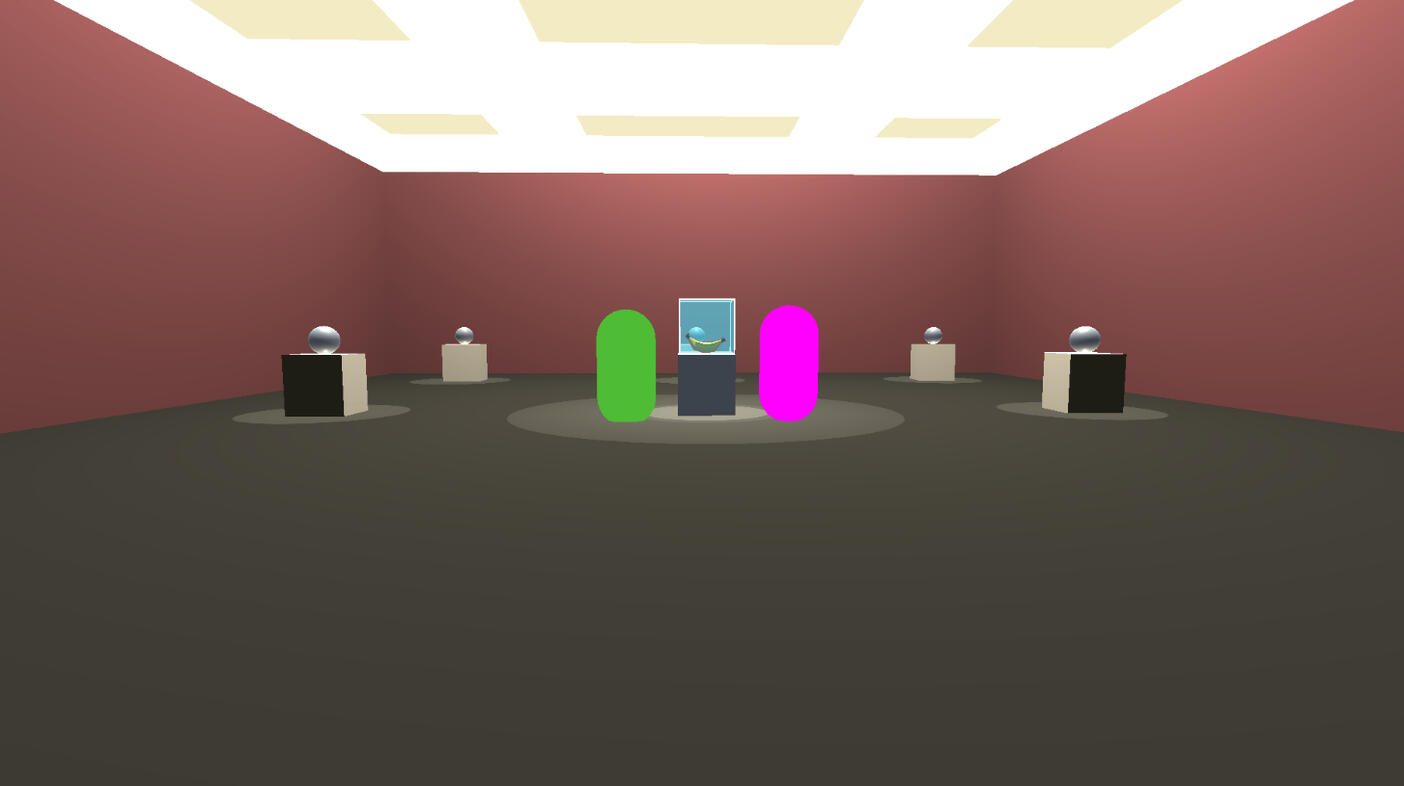
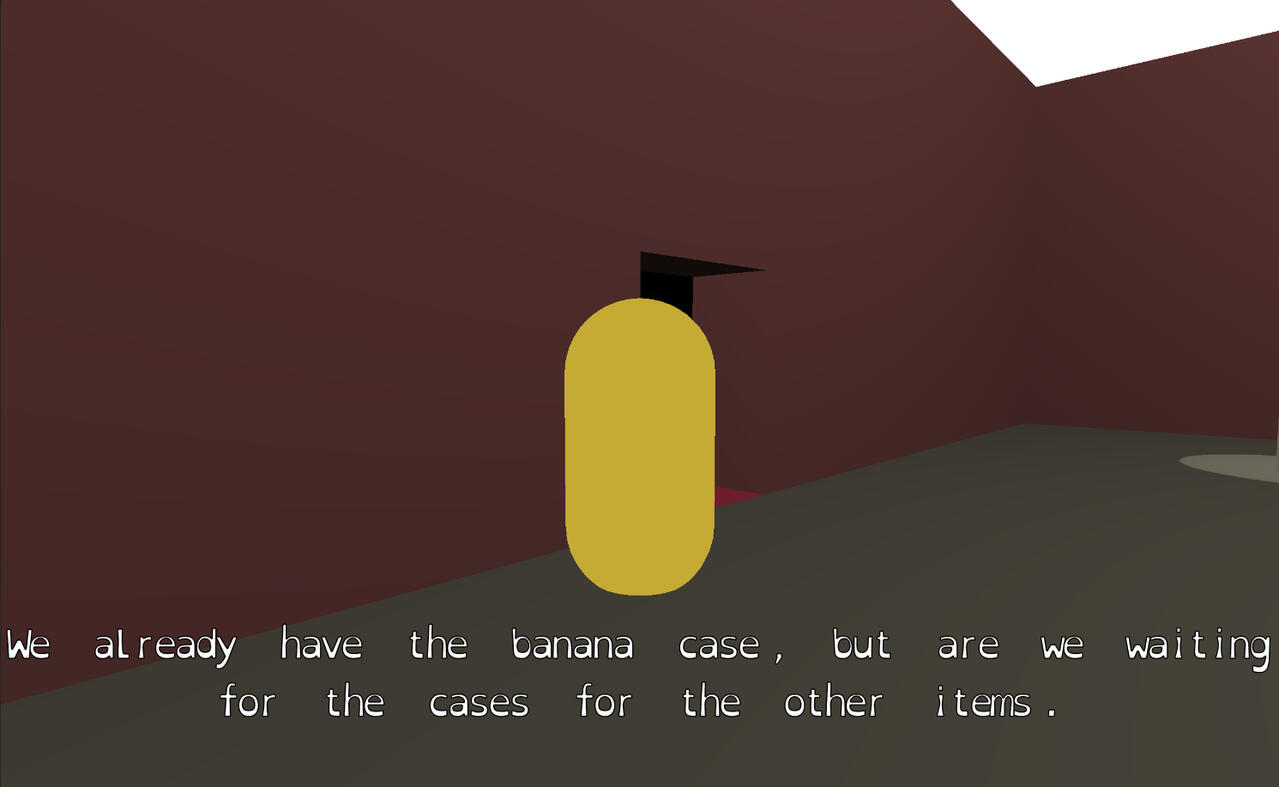
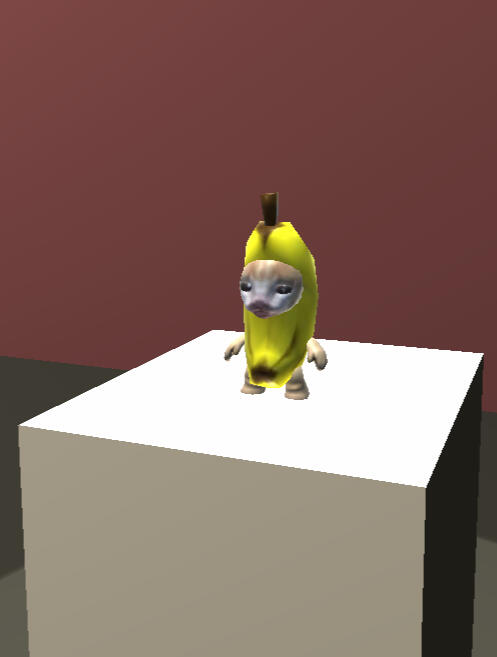
Initially I began designing level 1 in conjunction with two people that were part of the original team. We spent a brainstorming session together thinking about different things that seemed "dreamlike" and that could be fun to portray in a game, and that could ideally blend well with our already established word puzzle mechanic.The main things that stuck out in our conversation were the idea of a museum with weird and silly items on display that the player character had some sort of connection to, and the thought of picking up a banana and being able to actually talk to someone on the phone with it.The first version of the level is an extremely direct product of this conversation. The player would walk into a museum full of silly pop culture references, where nothing except the ringing banana in the center had a glass case, and by talking to different guards, they would remove the banana's glass case and be able to pick up the phone and progress to the next level.
,
,
Early Improvements
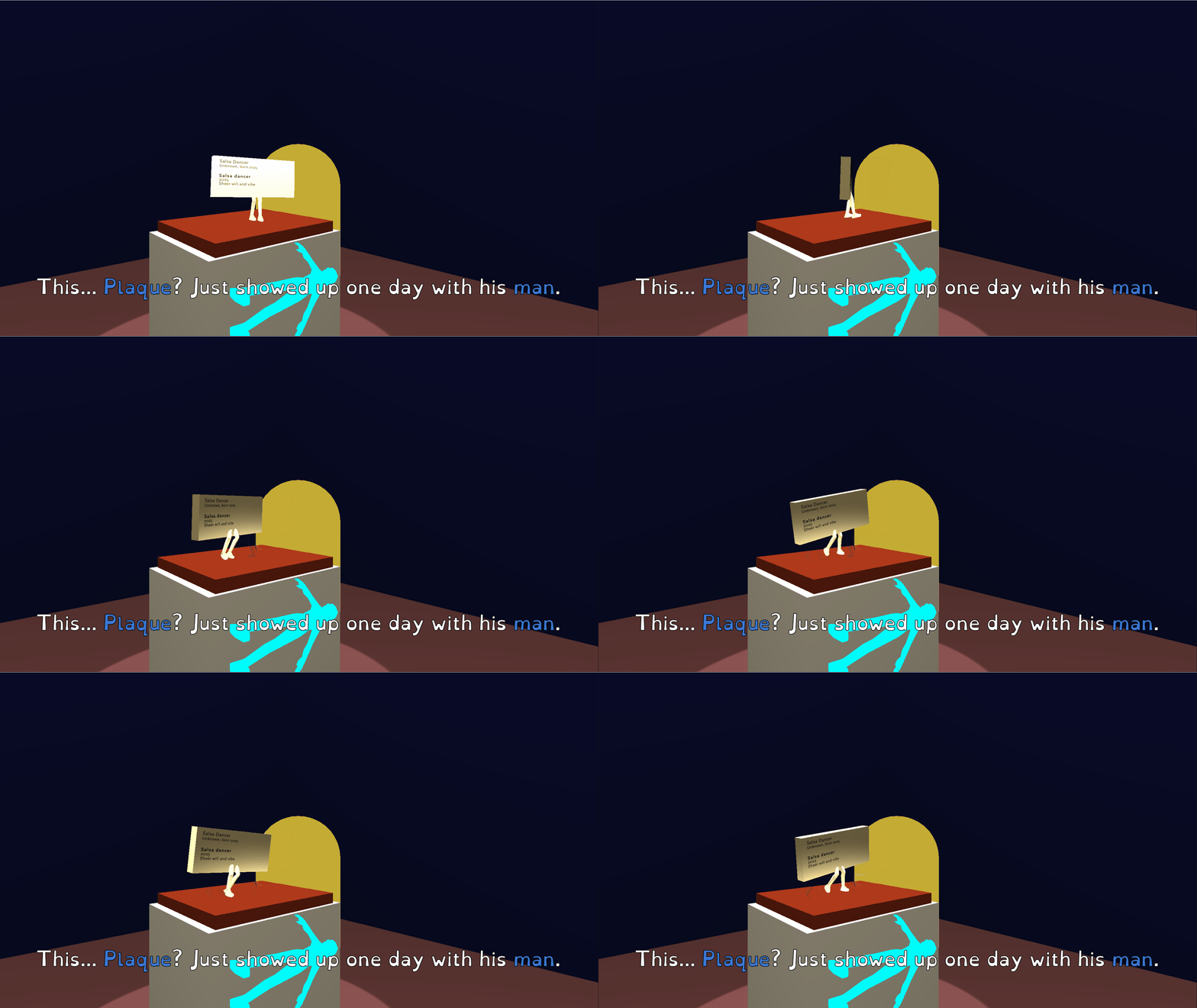
Very early on we could already tell that there was a lot of growing room. The level served as an interesting enough (if a bit hard) introduction to the word puzzle mechanic, but beyond that simple satisfaction, and the sillyness of the banana phone, there was little else they were connecting to. We set to solve this issue in two main ways.The first one was to try to connect the level more strongly to the character backstory that we were developing. We did this by turning a lot of the items on display at the museum into objects that were of extreme relevance to the dreamer's life, such as her sister's teddy bear.On the other hand we also leaned even further into the syliness of dreams, but instead of having random silly items inserted into the environment, we incorporated surreal and dreamlike logic into humorous optional word puzzles. This led players to be much more excited about word puzzles, as they looked forward towards seeing what the results would be beyond what was purely useful for them.
,
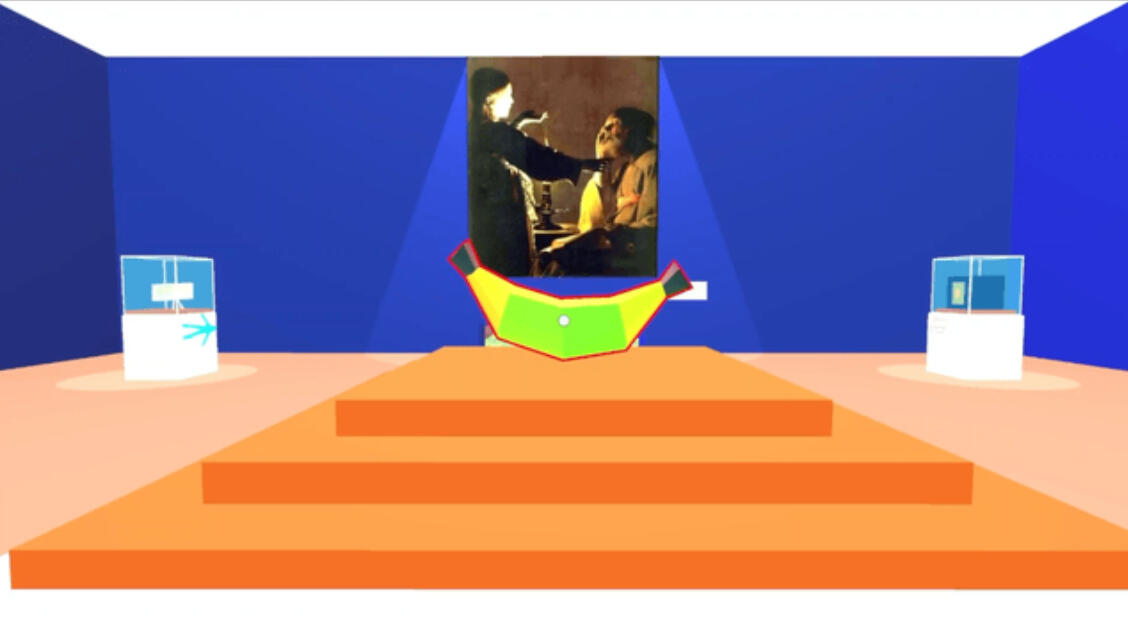
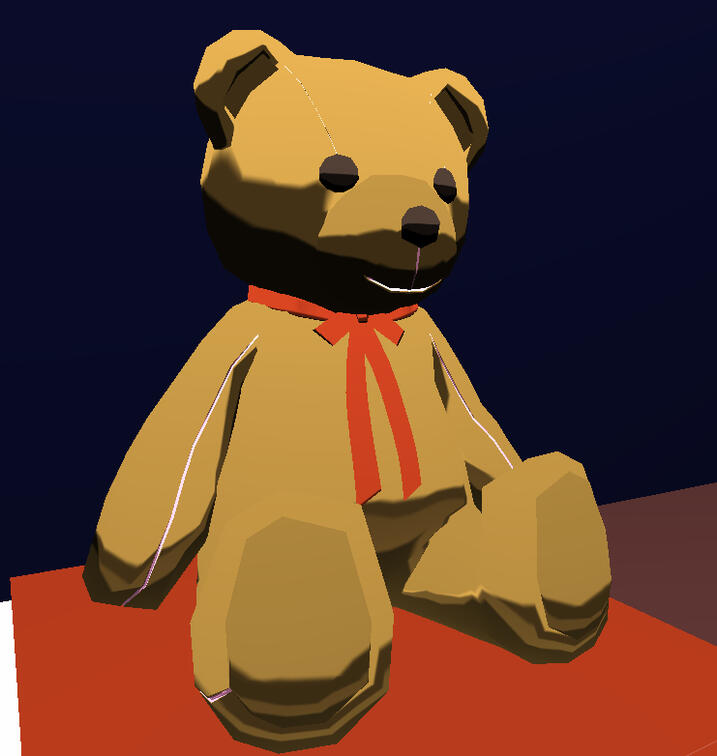
,
From Museum to Library
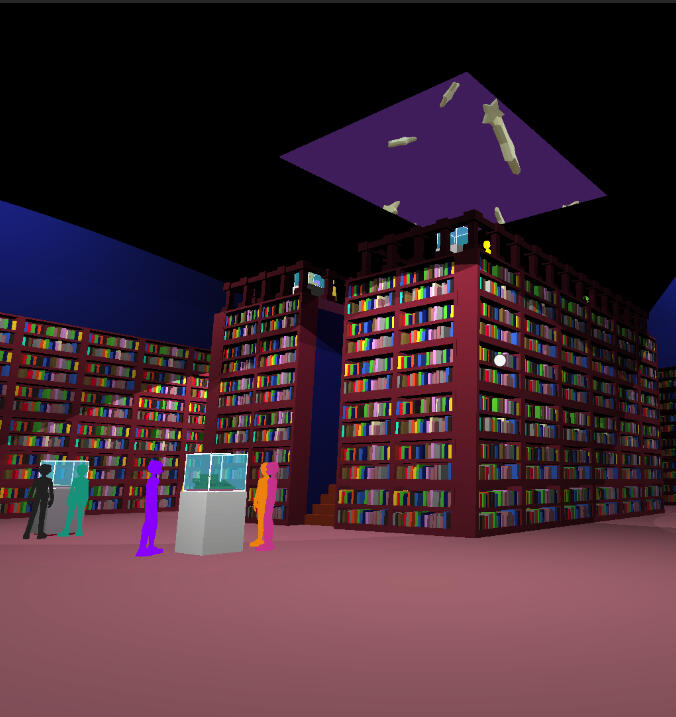
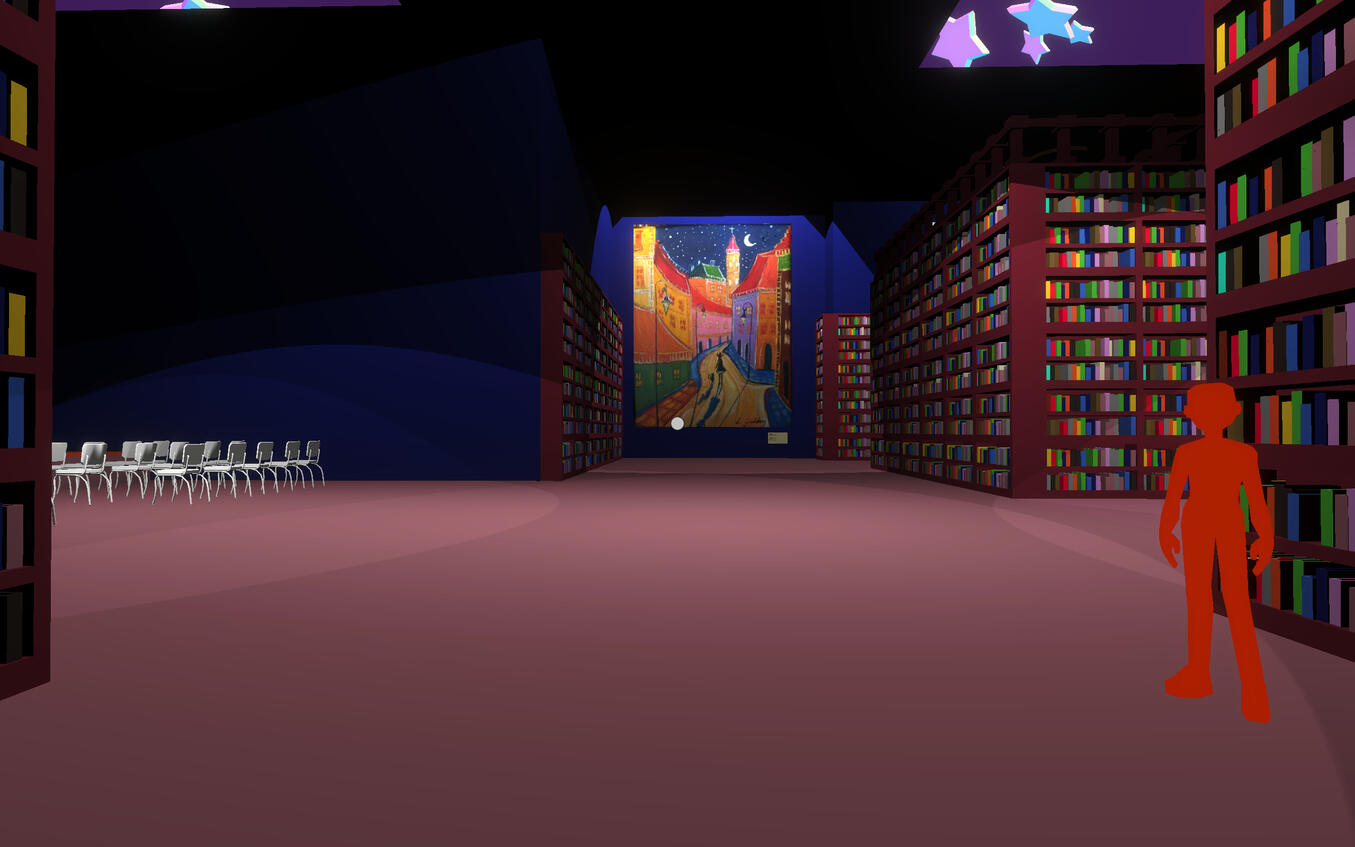
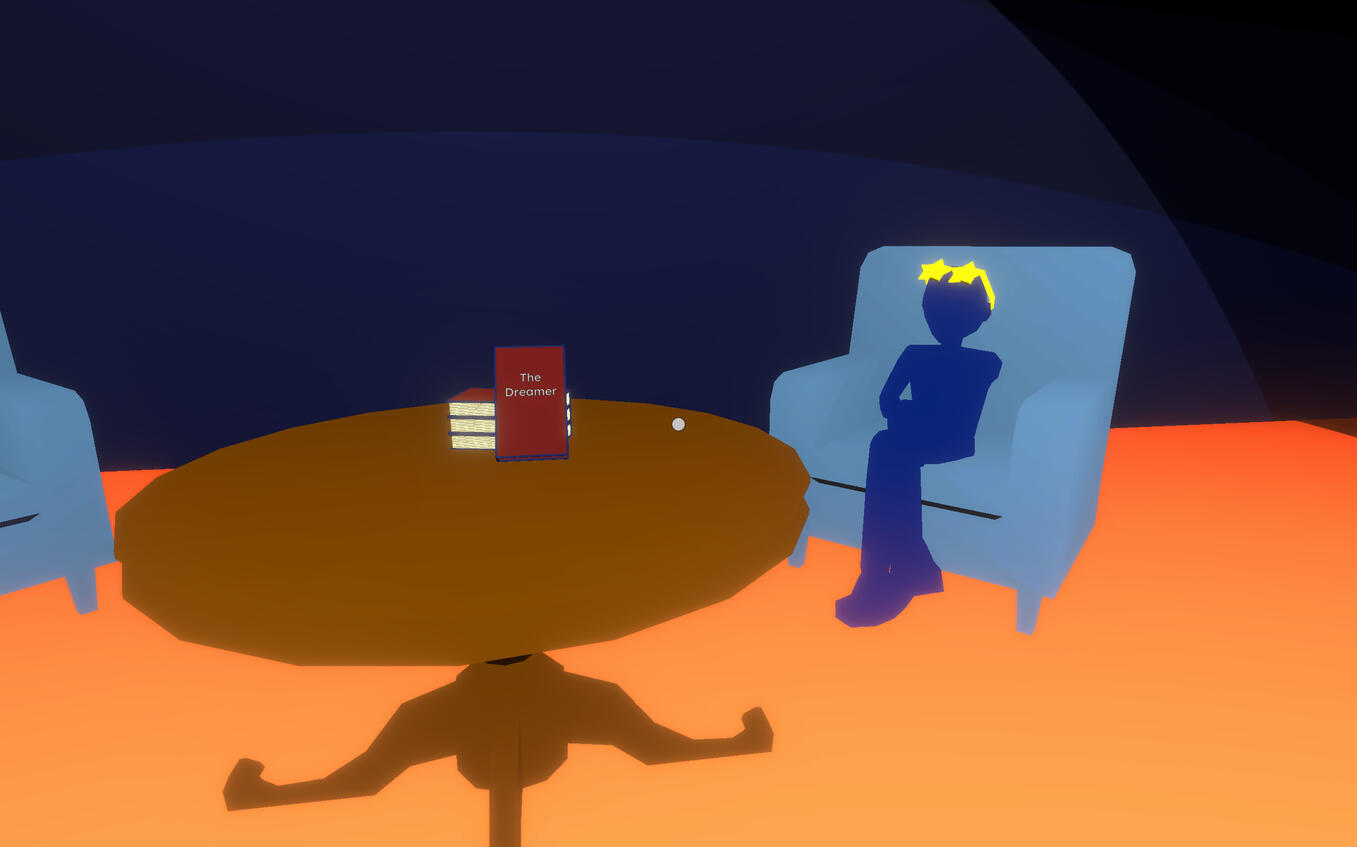
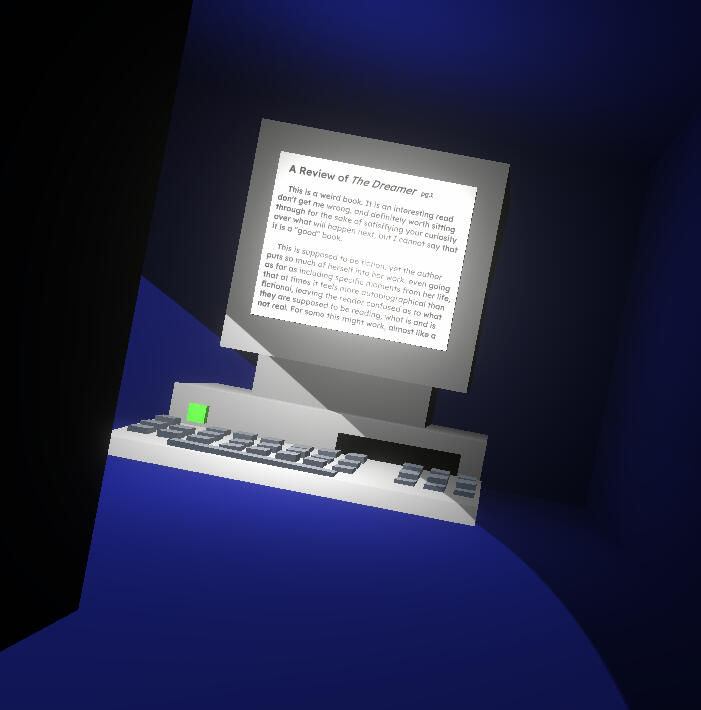
It was at this point in the timeline that the two people who had been working with me on the level left the project, and I was left as the sole custodian of Chapter 1. This meant more work, but also that I had the opportunity to carry out a major overhaul in the level, and so I did just that, turning our museum into a library with a temporary exhibition.The main theme of this overhaul was taking what we succesfully implemented in the last revisions and making it part of the core experience of the chapter. Instead of the specific items on display being referencial to the character's backstory, the whole level was now a symbol of the dreamer's aspirations as a young writer, an exhibition in a library dedicated to her writing, followed up by a book tour style interview.Now every item that was on display could be interacted with. The ones necessary for progression were easier than the optional items, and every single one would have some sort of silly effect, while still being relevant to the character's backstory.
,
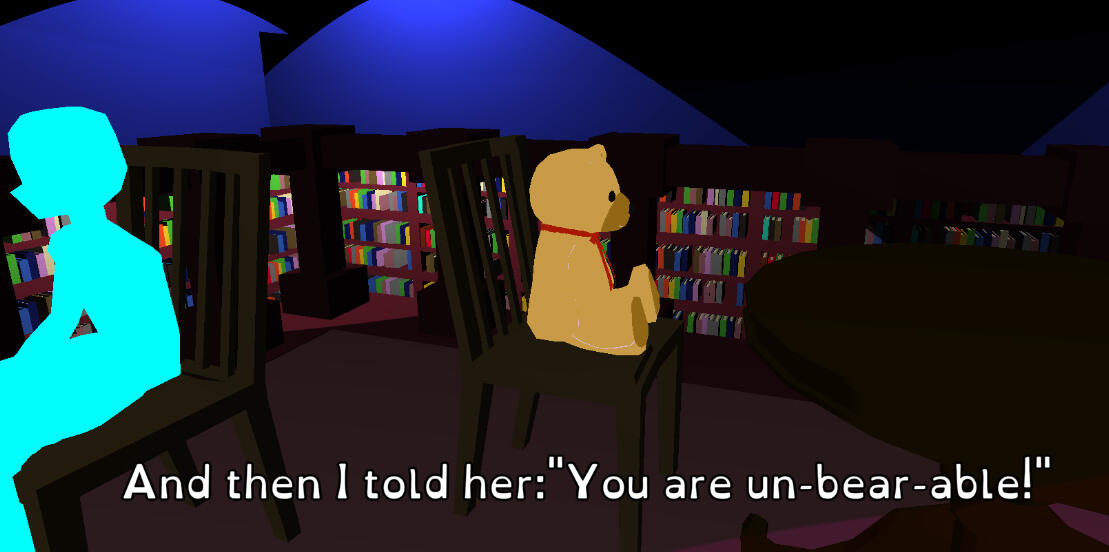
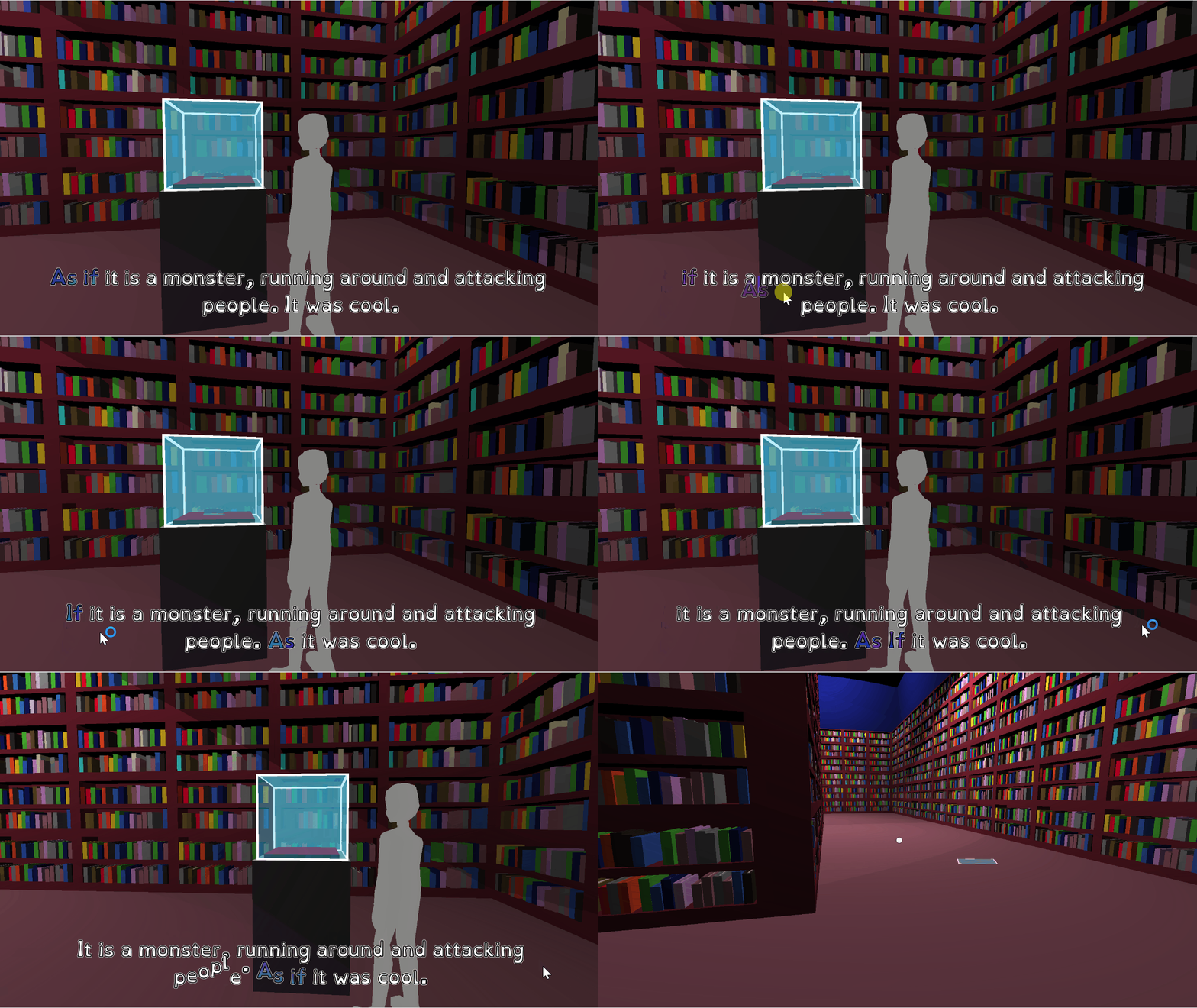
,
Final Tweaks
The new version of Chapter 1 was a big success in playtesting, which meant that it was time for me to mostly move on from it so I could help with other levels, lead the development of Chapter 4 and 5, and focus more on fixing bugs and implementing sound effects with our sound designer. However, there were still some small changes and additions to be made, such as small visual additions, and an addition of a secret side room.The most time-consuming change was moving the interview stage to the front and left of where the player enters the room, and moving all the other elements to the right. I noticed during playtest that the overwhelming majority of players just beelined to the items before talking to interviewer, which meant that they were solving puzzles without knowing whether there was any specific goal or objective that they had. While playtesting the tutorial, I had seen just how reliably players would talk to an NPC on the left before talking to the NPC on the right, and so I decided to try to apply that principal of left-to-right order to the positioning of the interviewer stage, and while being far from failproof, I did notice a considerable increase in the amount of players that talked to the interviewer before going towards the items.
,
,
Gameplay and System Design
Dreamscape's Dialogue System
Chapter 1 of Dreamscape was the first level that I worked on in this game, and it was also the level that und
The dialogue and puzzle system for Dreamscape was the biggest undertaking I had while working on the game, as I was the one that originally had the idea, and have been essentialy solely responsible for its development and maintenance throughout development. Here I want to look back through the development of the mechanic, and look through the different challenges and decisisons that I had to face through the process.
First Prototype
The initial idea for the puzzle system came from thinking about dreams and metroidbranias. Originally, Dreamscape was meant to follow a "Metroidbrania" styled structure, where the player finds out about new mechanics throughout the game that recontextualize places and interactions that they had previously had, giving the player what Tunic developer Andrew Shouldice has called the "This was here the whole time" feeling.Thinking about games and dreams, I thought about how cool it would be for a player to talk to NPCs the entire game without knowing they could secretely move their words around the whole time, and change the environment that way.I quickly whipped up a dialogue system that would spawn in each individual word as its own unqiue GameObject that could be dragged and dropped by the player, and that would reorganize the order of words depending on where it was dropped. Using UnityEvents I was also easily able to connect whatever script and method I wanted for the dialogue to activate when the correct sentence order was achieved.
,
,
Making it an actual Dialogue System
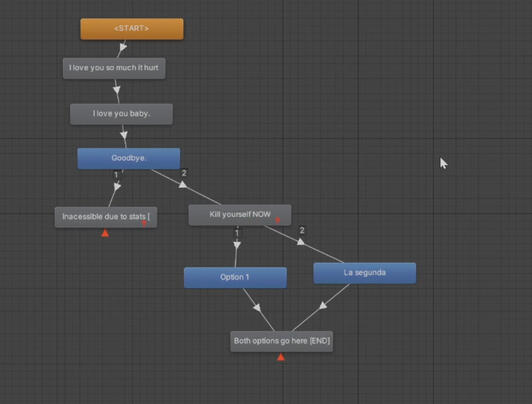
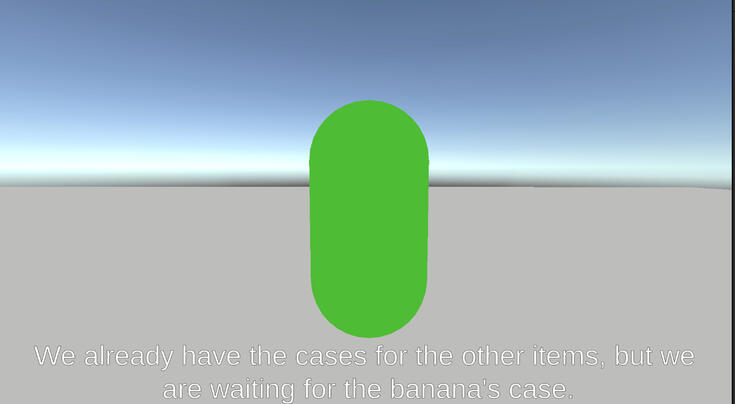
The initial prototype for the puzzle system was great for seeing how well the base idea worked for puzzles, but it was not very good at being an actual dialogue system, as it could only handle one line of dialogue at a time, and there were no dialogue choices for the player.To remedy this I decided to use the Pixel Crushers' Dialogue System for Unity plug-in as a base to make a new iteration of the system. The plug-in would make it significantly easier to implement dialogue trees with branching conversations, player choices, and keeping track of variables that could be referenced when deciding what node to go to. The node-based dialogue would also make it easier for other people on the project to create new dialogue and iterate on it.Other issues that had to be tackled were making the dialogue system be able to handle punctuation properly (treating them as their own object while not having the spacing of actual words), and making it be able to have two lines of dialogue on screen at the same time, because only being able to have one at a time was seriously limiting what puzzles and dialogue we could write.
,
,
Simplification and Expansion
As the project evolved, the dialogue system puzzles became the main mechanic for the game, the pincipal way in which we were going to challenge players and in which they would interact with the world. This made two issues that were already a problem for us even more prominent. The puzzles were often too hard, and sentences could be rearranged into almost anything.To solve this issue we decided to make only certain words movable, which made the puzzles a lot more accessible to the players, without adding really any extra work for the puzzle designers, as the process was essentially the same, now they just had to specify which words they had to move to find the solution when they were done.Additionally, to keep things interesting now that the players were going to be engaging a lot more with the dialogue puzzles than initially expected, new alternate puzzle words were added. These were homohpone words, which changed from one to the other every few seconds, and word bank words, which could be moved from one sentence to another if it contains an open space. This kept the mechanic much more fresh for the duration of the game, and Chapter 4 and 5 in particular rely extremely heavily on the word bank mechanic in particular.
,

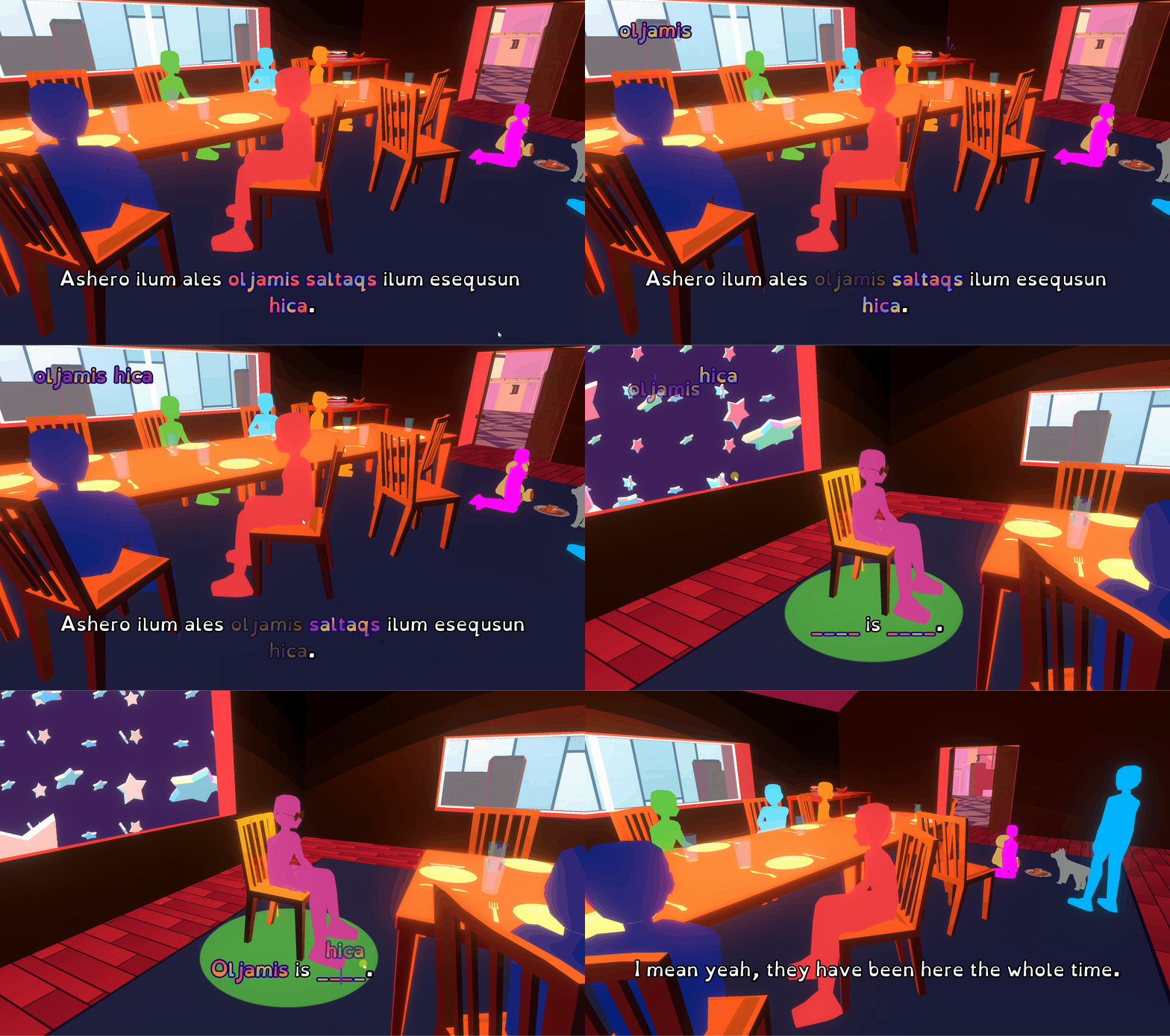
,
Bugfixing and Save System
Throughout the project there were a lot of bugs in the dialogue system that popped up. One example of this related to the word bank words specifically. What was happening was essentially that if the player put in a word bank word in an empty space, if the insertion didn't match a target sentence for a puzzle, and the player returned the word to their inventory before moving on from the dialogue node, once they returned to that node the word would still be there, meaning they had duplicated the word.It took hours to figure out what was going wrong, but what it turned out was happening was that when the word was being put in, it was referencing the correct dialogue node and changing it in the database, adding the word to the sentence, but if they removed the word right after without first exiting the dialogue, the word's script still had the dialogue script it had originally came from as its parent Dialogue, so when it was being removed it was trying to change a non-existent node in the wrong conversation in the database. The solution itself though was simple enough, I just had to assign a new parent Dialogue script when inserting a word into an open space.There was also some work to be done when we decided to implement a save system. Because the players are changing the dialogue in the database as they play the game, a new database had to be created. Now the "Used Database" copies every dialogue node from the "Original Database" when New Game is selected in the Main Menu.
,
,
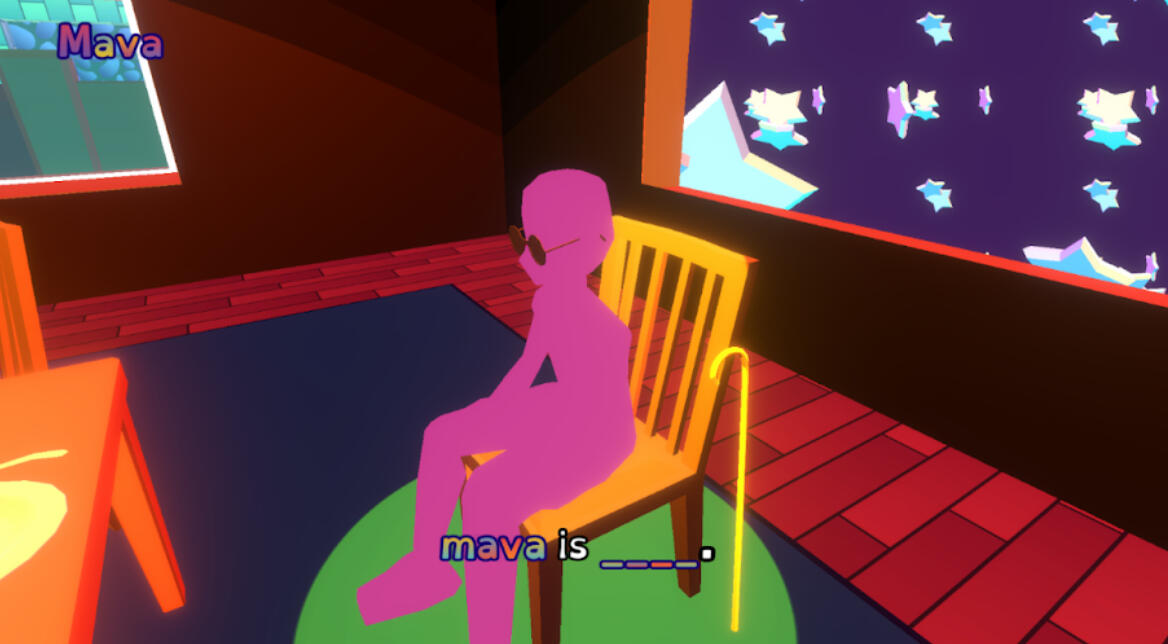
Total 11 Football Gameplay
Chapter 1 of Dreamscape was the first level that I worked on in this game, and it was also the level that und
Designing the systems for Total 11's gameplay and implementing it in code has been some of the hardest work I have ever done in game development. I knew that taking on what is essentially a 3D action game with multiple characters like this by myself was crazy, but I wanted to try anyways, and though far from done I am quite happy with what I have accomplished so far. Here, I want to go through the notes I took throughout the development process, and talk about the different decisions that I made had to make.
In Possession Movement - Take 1
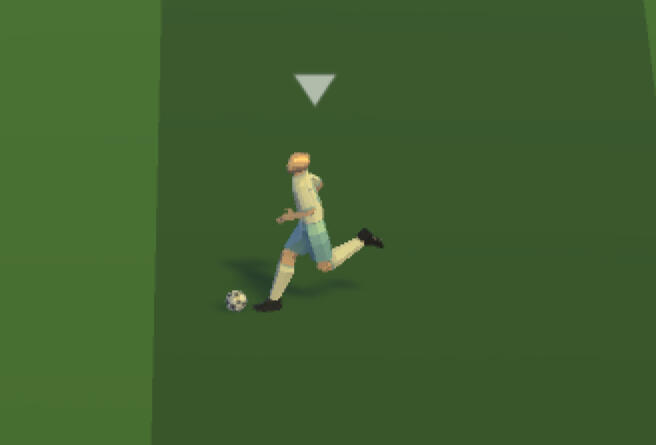
The first real task in developing the gameplay of Total 11, other than being able to control the player by itself, was figuring out how to control the player and the ball when in possession. One of the earliest decisions that I made when I started brainstorming the project was that the game, and the ball specifically, needed to have a real sense of physicality.Something a lot of soccer games do, such as Mario Strikers and even Captain Tsubasa, is have the ball magnetize to an orbit around the player, and automatically move to be in front of the player when they turn. This makes controlling the ball and character a lot easier for the player, and is relatively easy to implement. However, by doing this there is a significant loss in terms of the sense of physicality in the game. The ball stops feeling like a real object that is being kicked around by people, and more like an abstract representation of an object that they could be holding in their hands or in their pockets.Because of this I decided that the ball was only going to move when in posession when directly touched by the character's feet, using procedural animation to make the foot go towards the ball, and kick it in a player's inputed direction, after which the character would run after the ball.
,
,
In Possession Movement - Take 2
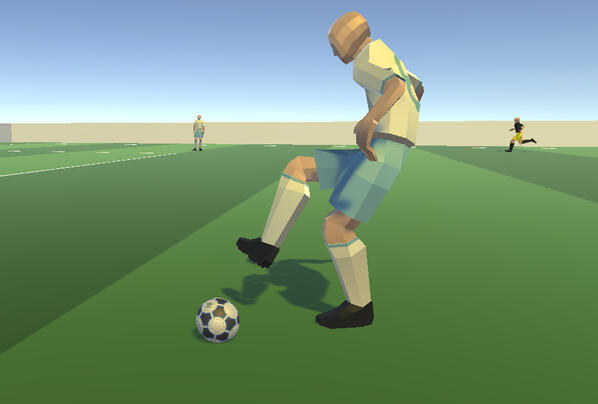
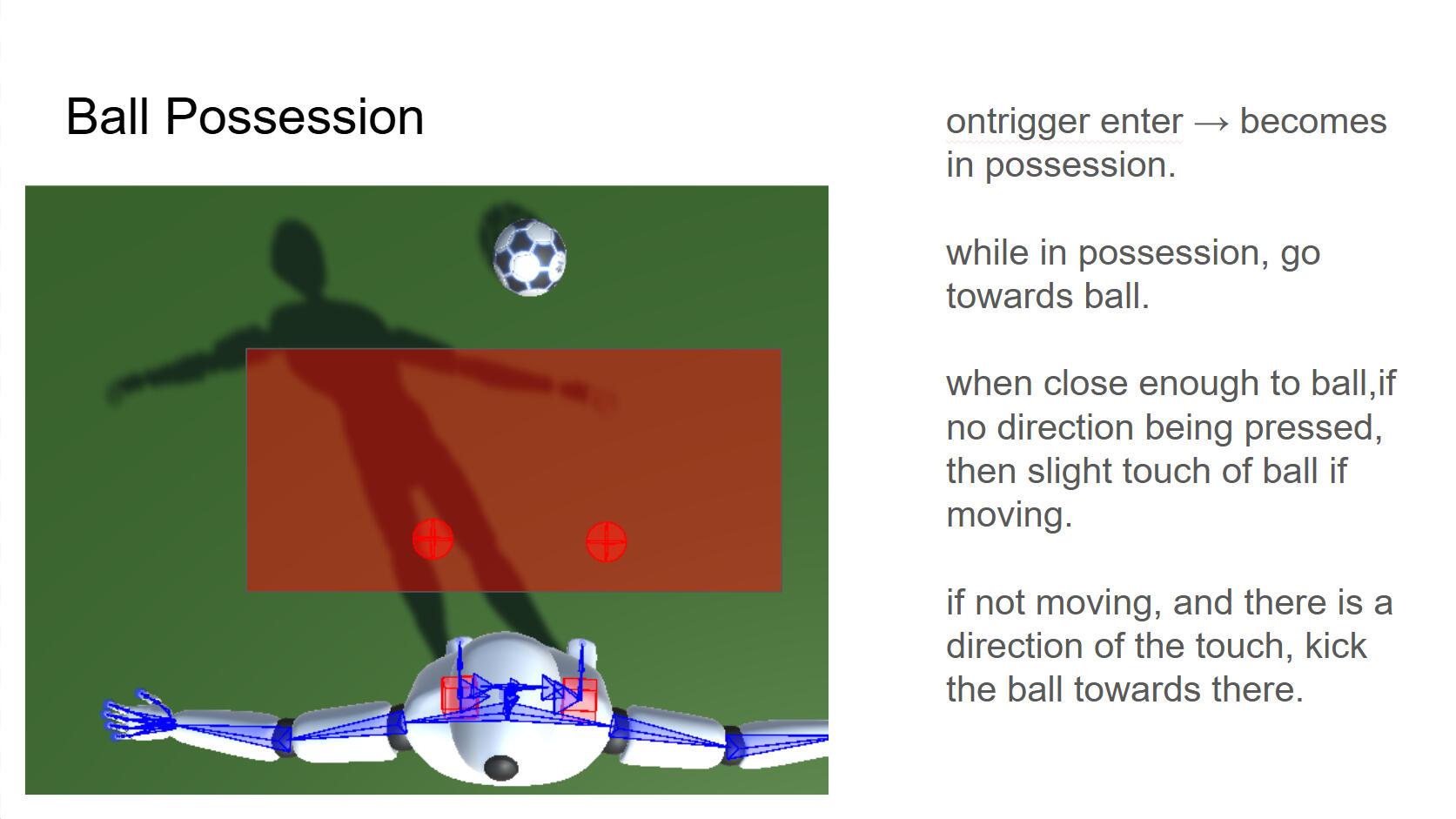
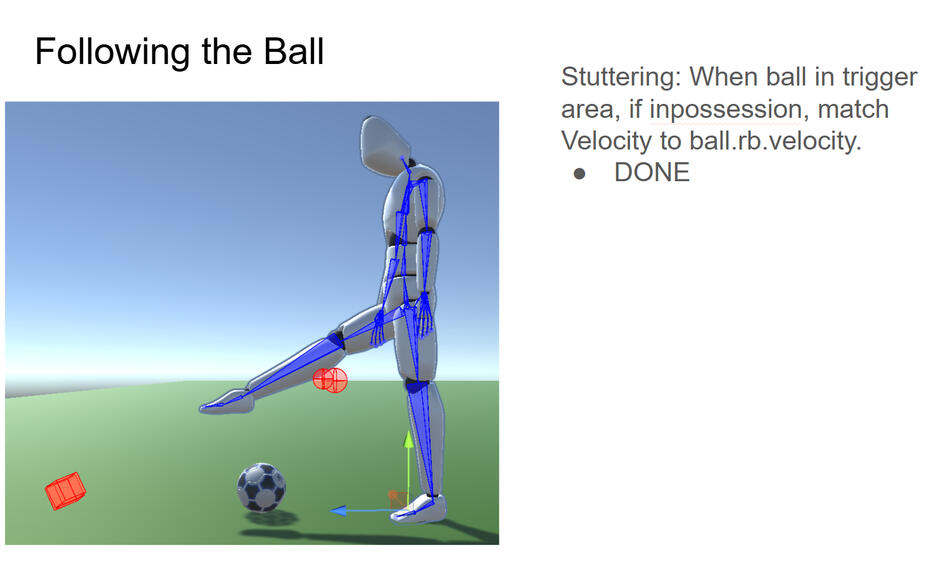
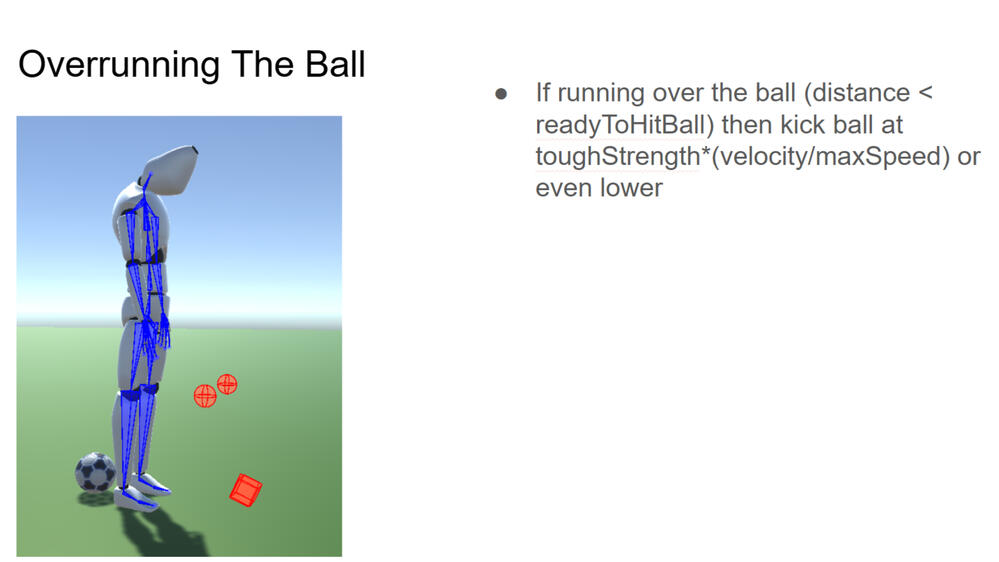
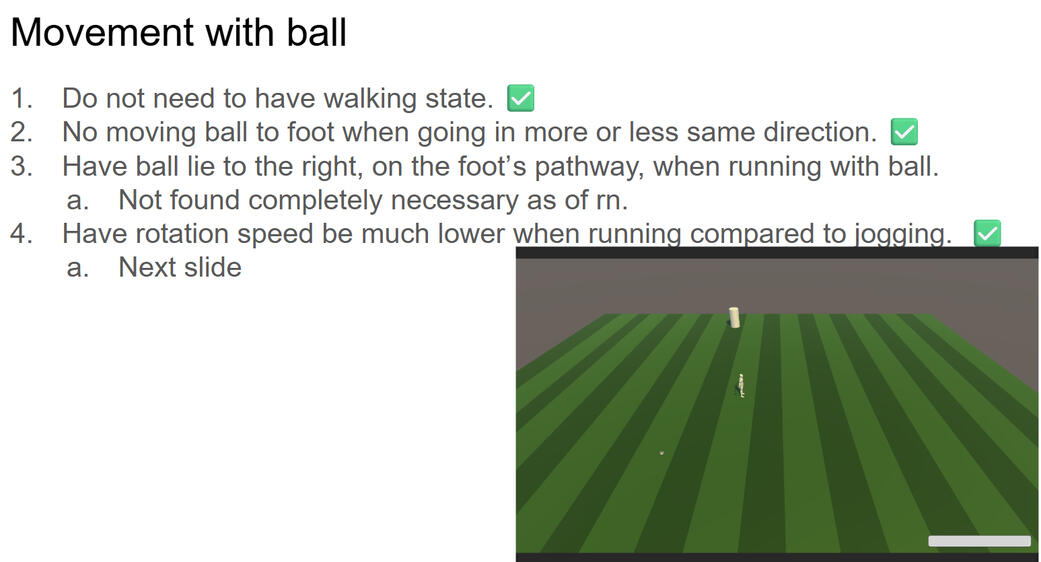
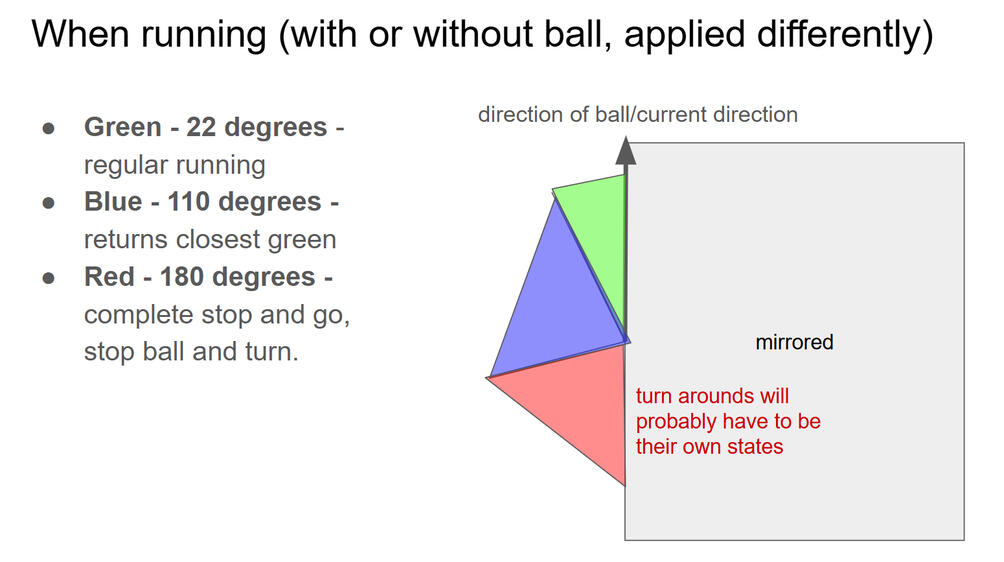
After trying to execute the previously described method, it turned out to be way too hard to execute by myself. The procedural animation did not blend properly with the handmade running animation, which made it all very stuttery and awkward looking. Because of that I decided to pivot, and adopt a simpler solution that I found while playing Pro Evolution Soccer 6.In PES, the game still had a sense of physicallity because of the ball only moving when "touched" by the player, the player being the one that follows the ball around, and the ball not orbiting around the player magnetically. However, the "touches" weren't being executed by the ball touching the player, but rather were just being triggered when the ball was close enough to the player. And it looked really good! At the speed that the game is being played, and how close the ball naturally gets to the feet when it is close enough to trigger a touch, this was a perfect solution, and what I decided to implement on the second attempt.I also took on a much more structured state-based approach to the way I wrote the Player Controller script on the second time around, which made implementing and mantaining old and new features a lot more sustainable.
,
,
Passing, Tackling, and Shooting
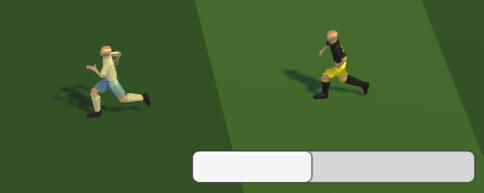
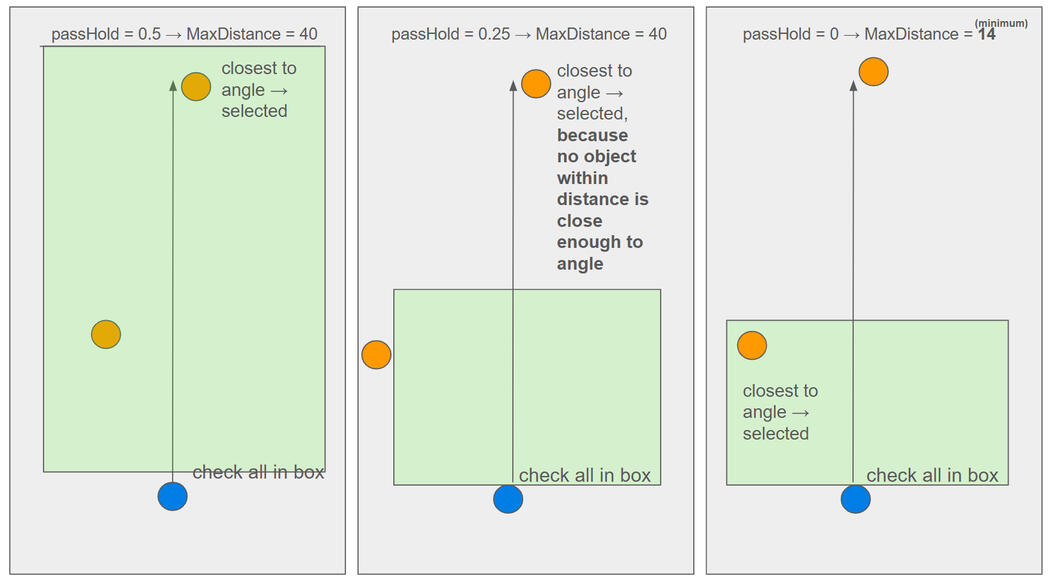
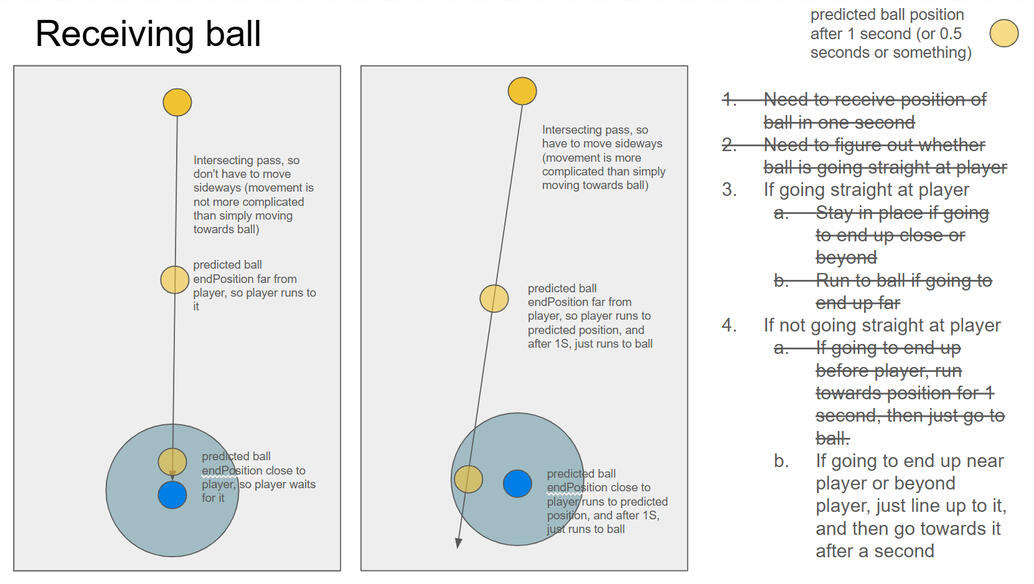
Figuring out how to do the passes, shots, and tackles was more simple than the player movement. These are mechanics that have extremely well established and consistent precedent across the history of football games, down to the placement of U.I. elements and the button placement for specific actions.Slide tackles, shots, and passes all are initiated by a simple button press, but the latter two's power is dependent on how long their buttons are held before they are released, which is signified by a meter on the bottom corner of the screen. Once the button is released, their shot/pass animation begins (with a different shot animation being played depending on how long the button was held for), and the force is applied to the ball at the point in their animations which corresponds best to the point in which the foot makes contact with the ball.A lot of work was also put in when figuring out behavior related to passing, namely how to act when receiving a ball, and how to help the player's pass be more accurate. When the player is making a pass, the script tries to find who the player was trying to pass to, taking into account the power of the pass and the direction being held, and immediately switches control to that receving player. As soon as that happens, the receiving player goes into a Receving Pass state, where they will wait in place for the ball or run towards it depending on how far away it is and how quickly it is coming towards them.